For years, a mobile money wallet was an island. You could send money to anyone on the same network, but sending to a friend on a rival network or to a bank account meant cashing out and depositing again. Interoperability, the ability to move money between different wallets and banks as easily as within one, has changed that in market after market. This guide explains how interoperability works technically and commercially, the models countries have chosen, what it means for a new wallet, and how to build for it from day one.
What "interoperability" covers
The word is used for several different things. It helps to separate them:
| Type | What it means | Example |
|---|---|---|
| Wallet-to-wallet (P2P) | Send from a wallet on one provider to a wallet on another | A customer sends to a friend on a different network |
| Wallet-to-bank and bank-to-wallet | Move money between wallets and bank accounts | Salary from a bank account into a wallet |
| Merchant interoperability | Any wallet can pay any merchant's till or QR code | A shop accepts payments from every wallet with one QR |
| Agent interoperability | Customers of one provider can cash out at another provider's agent | Shared agent networks in rural areas |
| Cross-border interoperability | Wallets in different countries send to each other | Regional remittance corridors |
Most countries started with wallet-to-wallet transfers and wallet-to-bank links, then moved on to merchant payments. Agent interoperability is less common because agents' float and commissions are tied to each provider.
How interoperability spread across Africa
Tanzania is often cited as the first market in Africa where rival mobile money providers connected their wallets for person-to-person transfers, starting in 2014 through bilateral agreements between operators. Ghana launched a national mobile money interoperability service in 2018 through its national switch, GhIPSS, connecting wallets and bank accounts. Kenya's main mobile money providers made person-to-person transfers across networks possible in 2018. Since then many central banks have made interoperability a policy priority, and regional initiatives such as the Pan-African Payment and Settlement System (PAPSS), launched in 2022, aim to connect payments across borders in local currencies.
Open-source switching software has helped too. Mojaloop, backed by the Gates Foundation, provides the core of an inclusive instant payment switch that several countries and regions have adopted or piloted.
The three architectural models
1. Bilateral connections
Each provider connects directly to each other provider. It is quick when there are two or three players, but the number of connections grows rapidly with every new entrant, and each pair negotiates its own terms. Smaller providers struggle to get connected at all.
2. A central switch or hub
Every provider connects once, to a switch, which routes transactions and handles clearing and settlement. The switch may be run by the central bank, a bank-owned company or a private operator. It lowers the cost of joining, standardises messages and rules, and gives the regulator a single point of oversight. Most national interoperability schemes use this model.
3. Aggregators
A third-party aggregator connects to many wallets and banks and offers a single API to others. Useful for fintechs and merchants that want reach without negotiating with every provider, but the aggregator's fees and reliability become part of your service.
How an interoperable transfer actually flows
Take a customer of Wallet A sending 1,000 to a customer of Wallet B through a national switch:
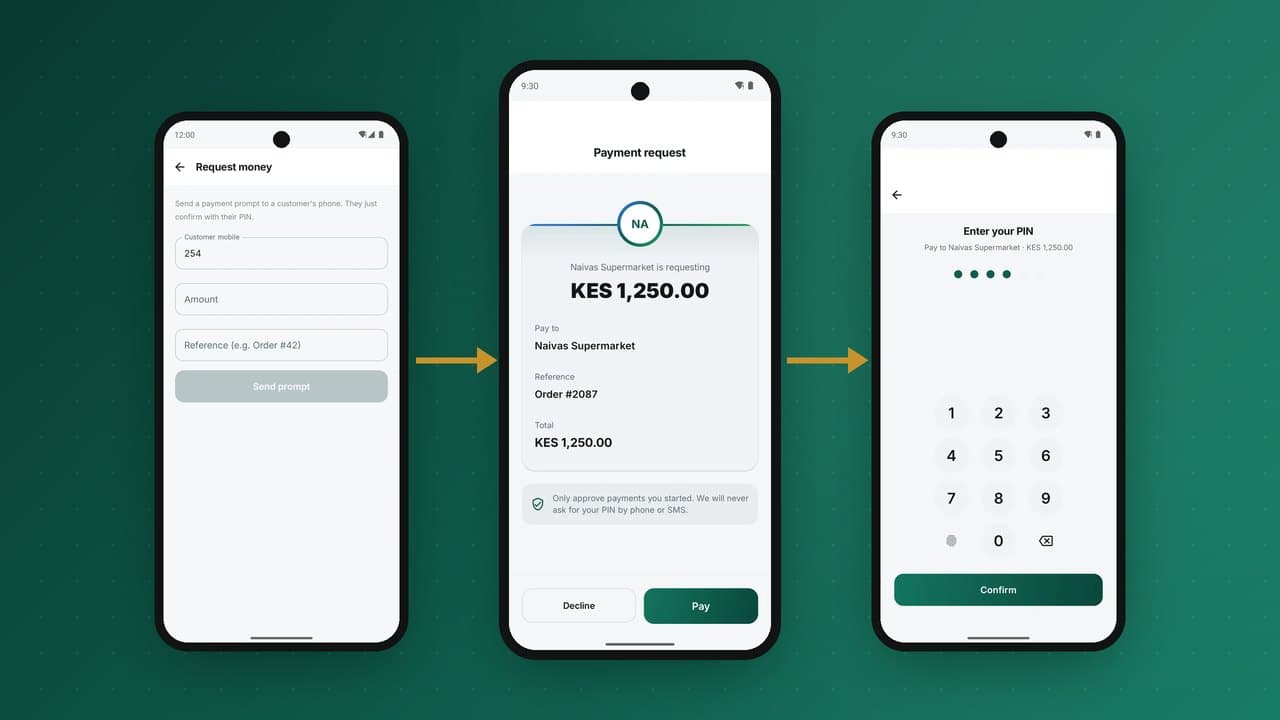
- Lookup: Wallet A asks the switch who owns the recipient's phone number, and gets back Wallet B and, usually, the recipient's registered name for confirmation.
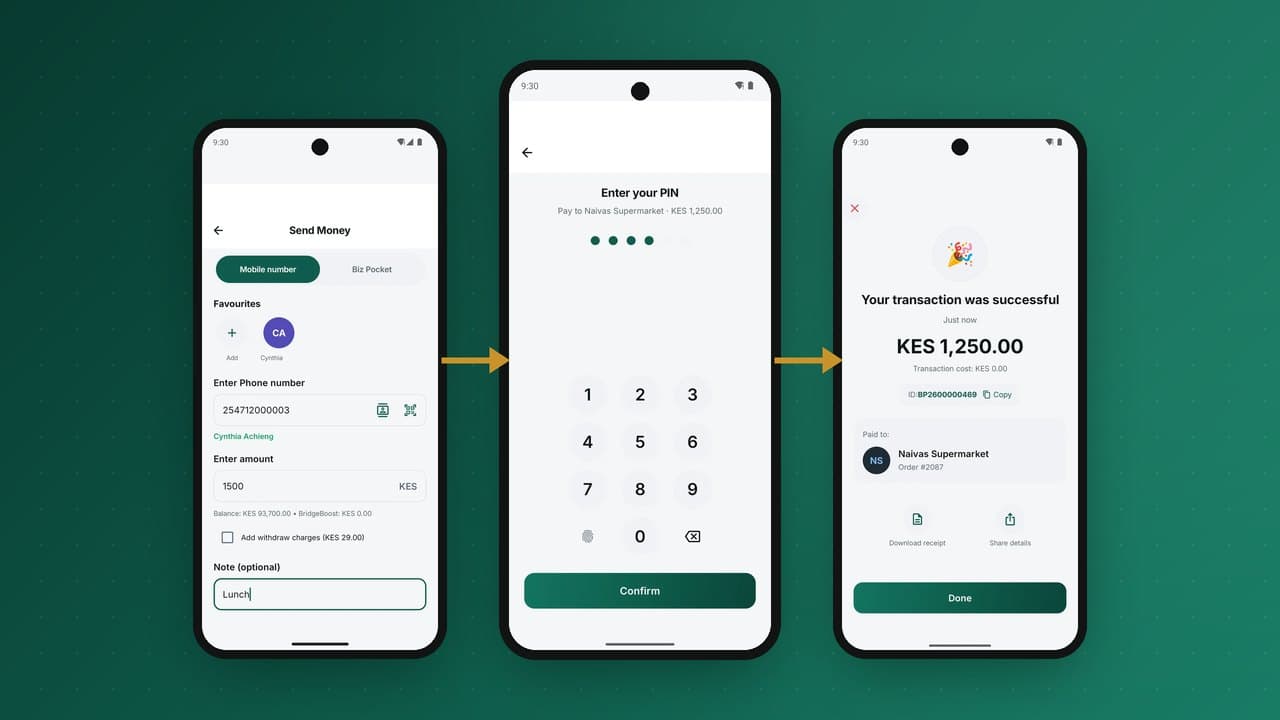
- Quote: Wallet A shows the customer the fee and the recipient name, and asks for confirmation and PIN.
- Debit and reserve: Wallet A debits the customer and moves the amount into an "interoperability outbound" clearing account on its ledger.
- Transfer request: Wallet A sends the payment message to the switch, which forwards it to Wallet B.
- Credit: Wallet B credits its customer from its "interoperability inbound" clearing account and confirms.
- Confirmation: the switch confirms to Wallet A, which finalises the transaction and sends receipts.
- Settlement: at agreed intervals, the switch calculates the net position between all participants and settles through their accounts at the settlement bank or central bank.
Two properties make this safe. First, each step must be idempotent: if a message is retried after a timeout, it must never credit twice. Second, every in-flight amount must sit in a clearing account on the ledger, so at any moment the provider knows exactly how much is owed to or by the switch, and reconciliation against the switch's settlement report is mechanical.
The hard part: timeouts and uncertain states
Within a single wallet, a transfer either happens or it does not. Across networks, there is a third state: we sent the request and did not hear back. Handling that state well is what separates a trustworthy interoperable wallet from one that generates support calls:
- Keep the transaction in a clear pending state, visible to the customer, rather than showing a failure that might not be one.
- Query the switch for the final status before deciding anything.
- Reverse the customer's debit automatically only when the switch confirms failure, and never after the recipient was credited.
- Reconcile every pending item against the switch's reports daily, and resolve exceptions with an audit trail.
The same pattern applies to wallet-to-bank transfers, bill payments and any external rail. A platform designed around pending states and clearing accounts handles all of them the same way.
The commercial side: who pays whom
Interoperability has costs: the switch's fees, the receiving provider's costs, and the settlement process. Schemes use a few pricing mechanisms:
- Switch fees paid per transaction by participants.
- Interchange: a fee the sending provider pays the receiving provider, especially for cash-out-heavy flows where the receiver's agents bear the cost.
- Customer pricing: providers decide whether off-net transfers cost customers more than on-net ones. Regulators increasingly scrutinise large differences, which can undermine the purpose of interoperability.
For smaller wallets, interoperability is mostly an opportunity: their customers can reach everyone, not only other customers of a small network. For dominant providers, it can feel like a threat, which is why regulators often mandate it.
Merchant interoperability and QR standards
Once transfers are interoperable, the next frontier is payments at merchants. A shopkeeper does not want five QR codes on the counter. National QR standards, often based on the EMVCo merchant-presented QR specification, let one code accept payment from any participating wallet or bank app. The merchant's provider receives the payment through the switch and credits the merchant. We cover merchant payment methods in QR codes, tills and prompts.
Standards that matter
- ISO 20022: the global messaging standard for payments, increasingly used by national switches and instant payment systems.
- ISO 8583: the older card-era standard, still found in many bank switches.
- EMVCo QR: the merchant-presented QR payload most national QR standards build on.
- Scheme rulebooks: each switch publishes rules on message flows, timeouts, dispute handling and settlement; these are as important as the technical format.
Building a wallet that is ready for interoperability
Even if your market has no national switch today, it probably will soon. Build for it now:
- Rails as adapters. The core ledger should not know which switch or bank is on the other side. Each external rail implements the same operations, such as collect, pay out, check status and receive callbacks, so adding a switch is a self-contained piece of work.
- Clearing accounts per rail. Every external rail gets its own inbound and outbound clearing accounts, so exposure to each counterparty is visible at all times.
- Pending states and status queries built into the transaction lifecycle.
- Name lookup before confirmation, to reduce mistaken transfers.
- Idempotency keys on every external request and callback.
- Automatic reconciliation against switch settlement reports.
- Configurable fees for on-net and off-net transfers, so you can respond to scheme rules and regulator guidance without code changes.
A worked example of net settlement
Settlement is where interoperability becomes real money. Suppose three wallets (A, B and C) exchange transfers through a switch during one settlement cycle. The amounts are illustrative:
| From → To | Value sent |
|---|---|
| A → B | 9,000,000 |
| B → A | 6,500,000 |
| A → C | 4,000,000 |
| C → A | 5,200,000 |
| B → C | 3,100,000 |
| C → B | 2,400,000 |
Instead of six payments between the providers, the switch calculates each participant's net position: what it received minus what it sent.
| Participant | Received | Sent | Net position |
|---|---|---|---|
| A | 11,700,000 | 13,000,000 | −1,300,000 (pays) |
| B | 11,400,000 | 9,600,000 | +1,800,000 (receives) |
| C | 7,100,000 | 7,600,000 | −500,000 (pays) |
The net positions sum to zero. A and C pay a combined 1,800,000 into the settlement account, and B receives 1,800,000. Over 30 million moved between customers, but only 3.6 million moves between the providers' bank accounts. That efficiency is why switches settle on a net basis, and why each participant needs its ledger's clearing accounts to match the switch's settlement report exactly.
A checklist for joining a national switch
- Membership: meet the scheme's eligibility rules and sign its participation agreement.
- Settlement arrangements: open or designate the settlement account, and plan liquidity for net debit positions, including prefunding if the scheme requires it.
- Technical integration: implement the scheme's message formats (increasingly ISO 20022), security and connectivity.
- Certification: pass the scheme's test cases, including timeouts, duplicates and reversals.
- Operations: staff and processes for exception handling, disputes and daily reconciliation against the switch.
- Pricing and disclosure: decide customer fees for off-net transactions and publish them.
- Customer experience: name lookup before confirmation, clear pending states and receipts that show the receiving provider.
- Monitoring: extend fraud and AML rules to off-net flows, which have different patterns.
Agent interoperability: the next frontier
Sharing agents across providers promises lower costs and better rural coverage: one shop could serve customers of every wallet. The obstacles are practical: each provider's float is separate, commissions differ, and agents would need to manage several balances. Solutions being explored include shared agent networks run by independent operators, cash-out through the switch at any participating agent, and float pooling arrangements. For now, most markets rely on non-exclusivity, allowing a shop to be an agent for several providers side by side.
What interoperability means for customers
The customer benefits are simple and powerful: send to anyone, pay any merchant, move money between wallet and bank without cashing out. Evidence from markets that adopted interoperability generally shows growth in transaction volumes and a shift from cash-out-and-redeposit to direct digital transfers, which is cheaper and safer for everyone.
Cross-border interoperability
Interoperability does not stop at national borders. Regional initiatives aim to let wallets and banks in different countries exchange payments directly: PAPSS for payments across Africa in local currencies, regional economic communities connecting their national switches, and bilateral links between operators serving neighbouring markets. The same principles apply as domestically, with added layers: foreign exchange, cross-border compliance such as originator and beneficiary information, and settlement across currencies. A wallet built with rails as adapters and clear pending states can join these networks the same way it joins a national switch. More on the cross-border side in how wallets cut remittance costs.
Designing the off-net customer experience
Customers should not need to understand switches to send money. A few design choices make off-net transfers feel as reliable as on-net ones:
- show the recipient's registered name and their provider before the PIN is entered;
- show the fee clearly, including any difference from on-net transfers;
- show a pending state with a plain explanation if confirmation takes longer than usual;
- send the final receipt only once the receiving provider has confirmed the credit;
- make reversal of failed transfers automatic and visible, with a notification.
Key terms in interoperability
| Term | Meaning |
|---|---|
| On-net | A transfer between two customers of the same provider, settled inside one ledger. |
| Off-net | A transfer to a customer of another provider or a bank, which crosses a switch or bilateral link. |
| Switch | A central system that routes payment messages between member institutions and calculates settlement positions. |
| Name enquiry | A request to the receiving institution for the registered account name before the payment is sent. |
| Clearing | Exchanging and confirming payment instructions and calculating what each participant owes. |
| Settlement | The actual movement of funds between participants, usually through accounts at the central bank or a settlement bank. |
| Net settlement | Settling only the net difference between what participants owe each other over a period, instead of every payment. |
| Interchange | A fee paid between participants for an off-net transaction, set by agreement or by the scheme. |
| Reversal | Returning the sender's funds when an off-net transfer fails or cannot be confirmed. |
| Scheme rules | The contractual rules every participant signs up to: message formats, timings, fees, disputes and liabilities. |
Key takeaways
- Interoperability lets customers pay anyone, on any wallet or bank, and it grows the whole market.
- Most African markets now use a national switch rather than many bilateral links.
- The hardest engineering problem is uncertain states: timeouts, pending transfers and reversals.
- Show the recipient's name and the fee before the PIN, and send the receipt only once the credit is confirmed.
- Build rails as adapters so the same wallet can join a national switch, bank links and cross-border networks.
- Settlement, interchange and scheme rules matter as much as the technology.
Frequently asked questions
What is mobile money interoperability?
The ability to send money between wallets on different providers, and between wallets and bank accounts, as easily as within one wallet.
Who runs the interoperability switch?
It varies: the central bank, a bank-owned national switch or a private operator. Many countries use a central switch to which every provider connects once.
Is an interoperable transfer instant?
For the customer, usually yes. Settlement between providers typically happens later, in batches, through the switch.
Does interoperability make transfers more expensive?
Off-net transfers may carry switch and interchange costs. Providers decide how much to pass on, and regulators increasingly watch the difference between on-net and off-net pricing.
Can a new wallet join the national switch?
Usually yes, once licensed and certified against the switch's technical and operational rules.
PesaBridge treats every external rail as an adapter behind one ledger: each implements the same four operations (collect, payout, balance and callback), requests carry idempotency keys, charges move through a clear pending-to-completed lifecycle and webhooks are signed, so connecting a national switch, a bank or another wallet does not touch your core. See the connector catalogue or talk to our team.