Engineering · 11 min read
OAuth2 keys, a sandbox, a Daraja-style prompt-to-pay, and signed webhooks — integrate in an afternoon.
Free sandbox keys in minutes. Live keys after a short review.
# 1. Exchange your key pair for a 1-hour token
curl -s https://pesa-bridge.com/api/bridgepay/v1/oauth/token \
  -H "Content-Type: application/json" \
  -d '{"client_id":"pk_test_…","client_secret":"sk_test_…"}'

# 2. Push a payment prompt to the customer's phone
curl -s https://pesa-bridge.com/api/bridgepay/v1/partner/stk \
  -H "Authorization: Bearer $TOKEN" \
  -H "Content-Type: application/json" \
  -d '{"payer_msisdn":"254708374149","amount":250,
       "reference":"INV-1001","idem":"inv-1001-1"}'← 200  {"charge_ref":"STK0000123","state":"pending"}→ webhook  charge.completed  KES 250.00  ✓
Quickstart
Everything runs in the sandbox with test keys, so you can build the whole flow before any real money moves.
Sign up in the developer console. Test and live keys are issued straight away.
/developer/signupExchange your key pair for a Bearer token that lasts one hour.
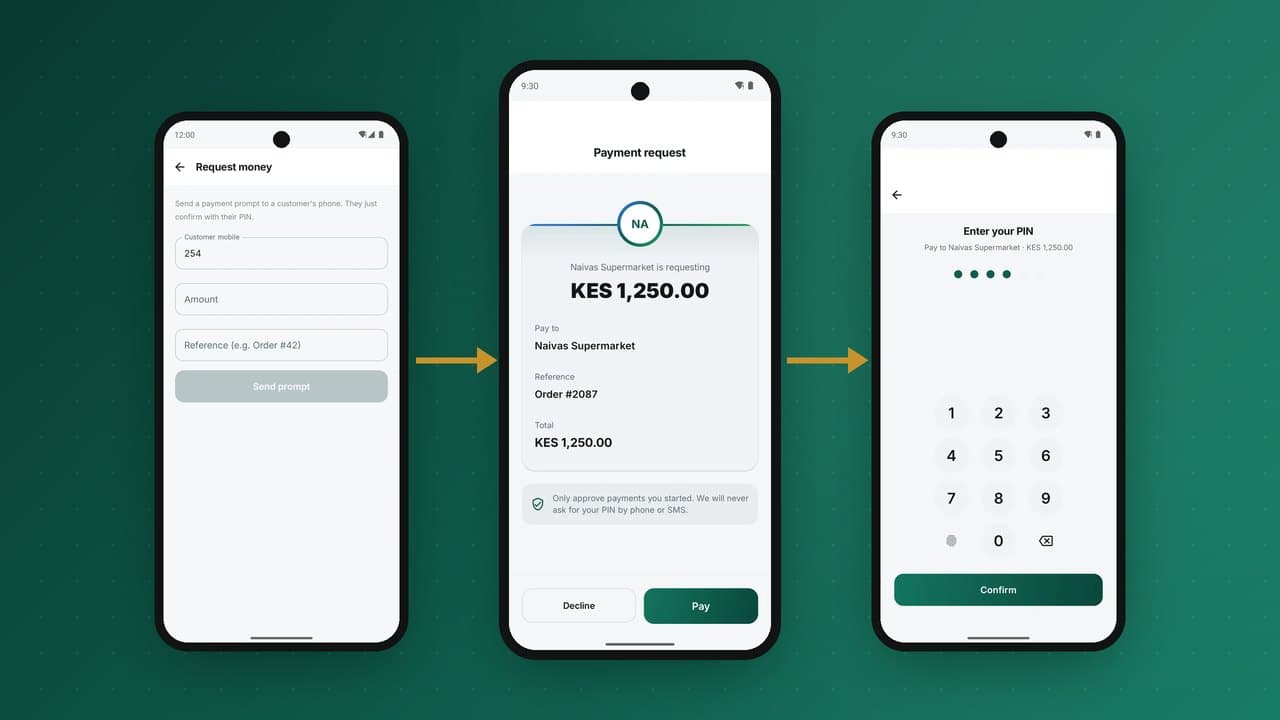
POST /oauth/tokenPush a payment prompt. The customer approves on their own phone with their PIN.
POST /partner/stkA signed charge.completed event tells your server the order is paid.
charge.completed ✓What you can build
53 endpoints in 12 groups, with one way to authenticate and one error format.
Designed for money
Most APIs move data. This one moves money — so it's idempotent, signed, and built around a charge lifecycle you can trust.
Authentication is OAuth2 client-credentials: you exchange a key and secret for a short-lived bearer token. Every state-changing call carries an idempotency key, so a network retry settles exactly once — the single most important property when real money is involved.
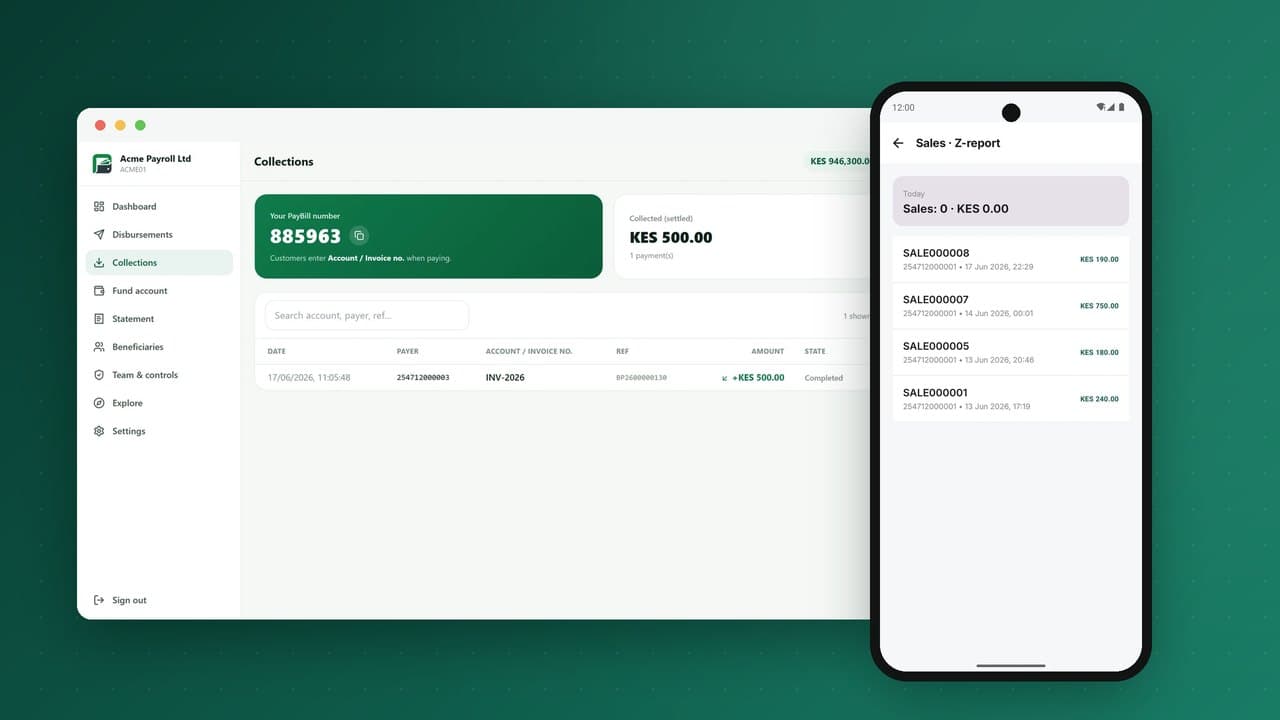
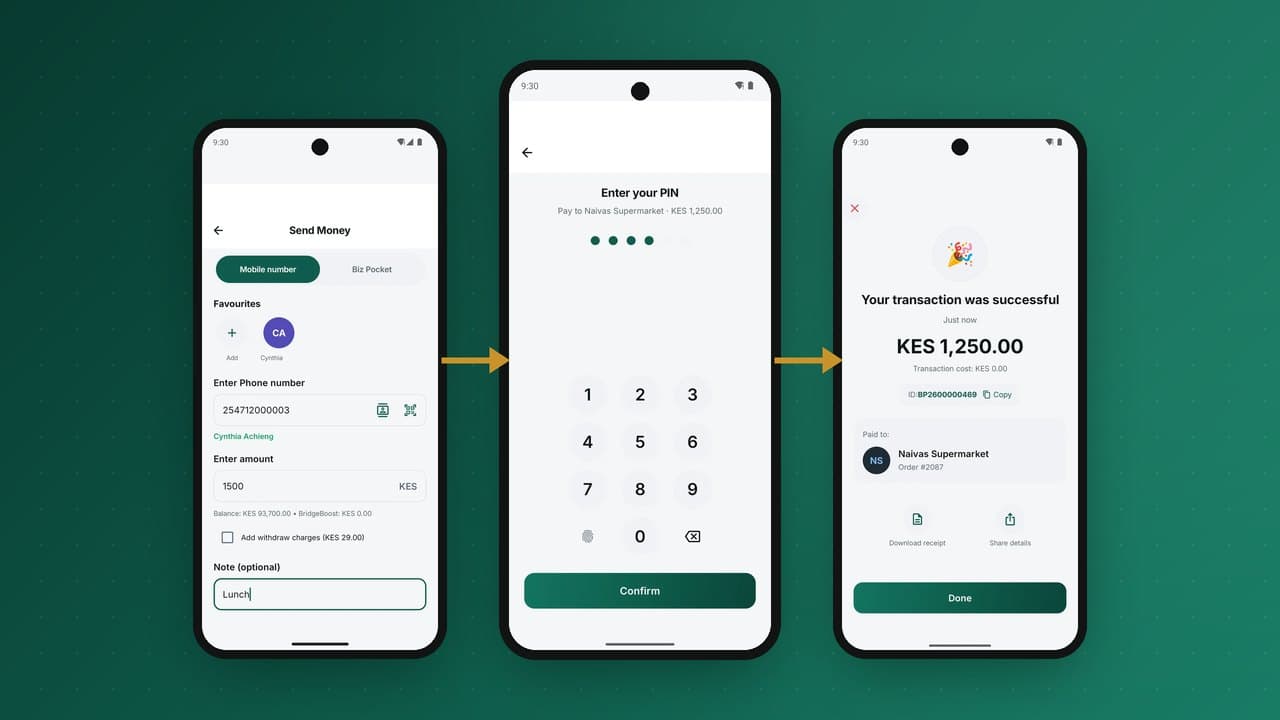
A collection is a charge. You push it to a customer's number; a prompt-to-pay lands on their phone; they confirm with a PIN. The charge moves through pending → authorised → completed (or declined / expired / failed), and you learn the outcome two ways: poll the status endpoint, or — better — receive a webhook the moment it changes.
Webhooks are signed with HMAC-SHA256 against a secret only you and PesaBridge share, and retried with backoff until your endpoint acknowledges — so you can build on them without fear of a missed or forged event. Balance and transaction endpoints close the loop for reconciliation, and a sandbox runs the identical contract, so you ship with confidence.
Charge lifecycle
{
  "event": "charge.completed",
  "charge_ref": "STK9F2A",
  "amount": 250.00,
  "currency": "KES",
  "state": "completed",
  "signature": "hmac-sha256…"
}
Tools
Explore, test and debug your integration without writing throwaway code or deploying a server.
API reference
/oauth/tokenExchange client credentials for a bearer token./partner/stkPush a charge (prompt-to-pay) to a customer./partner/statusPoll the state of a charge./partner/balanceQuery a collection account balance./biz/requestMerchant request-to-pay./ussdUSSD menu gateway callback.Security & compliance
Financial services live or die on correctness and control. PesaBridge bakes both into the core.
Every movement posts balanced debits and credits — the books reconcile to zero, always.
Configurable KYC tiers, per-transaction and daily limits, PIN attempts and wallet locking.
Idempotency keys stop double charges; a unified reversal engine unwinds any department.
HMAC-SHA256 signatures and retries so partner systems can trust every callback.
Immutable ledger entries and transaction history for regulators and disputes.
ID types, KYC rules and tariffs switch with the market, from configuration.
Going live
The same code runs in both modes. The key you use decides which. When your integration is ready, request live access and swap keys.
Countries you can launch in
Native apps, one platform
Channels — App · USSD · Web · API
Double-entry, always balanced
FAQ
Your own. PesaBridge is a product BridgeERP resells — every operator gets their own deployment, branded and configured for them. No shared database, no shared super-admin.
Any. Country, currency, language and KYC rules are configuration drawn from the full ISO set — not hardcoded. We have live markets today and stand up new ones without a rewrite.
Yes. The full wallet runs over USSD — send, withdraw, pay bill, buy goods, airtime, balance and statements — settling on the same ledger as the apps.
Yes. Rails are pluggable adapters — banks, mobile money, cards and PSPs — so you connect only what your market needs.
Weeks, not years. Configure your brand and country, wire your rails, then ship your apps, USSD code and web portals from one platform.
Every movement is double-entry and balanced to zero, PIN- and KYC-gated, with signed webhooks and a full audit trail for regulators.
Four native Android apps: a User app for customers, an Agent / Super-agent app for cash-in, cash-out and float, a Merchant app to accept and settle, and a Corporate app for bulk payouts with maker-checker approvals, which also runs as a web portal. iOS versions are on the roadmap.
Funds settle to the relevant wallet in real time. Every transaction produces balanced ledger entries you can reconcile, with statements and exports, and a GL bridge for your accounting system.
Yes — overdraft credit, MFI loans with schedules and portfolio-at-risk, goal savings, and savings groups (chama / merry-go-round) are part of the platform and switch on per market.
Yes. The Corporate portal and API run bulk disbursement to thousands of wallets with maker/checker approvals, payee books, scheduling and full reconciliation.
A single operator admin console runs brand, tariffs, KYC, the agent and merchant network, the ledger, reversals, support and KPIs — no code required for everyday operations.
You do. Each operator runs their own deployment with their own database — branded and configured for them. It's a product you resell as your own, not a shared SaaS tenant.
Further reading
Keep exploring
Book a demo and we'll stand up your brand, country and rails — and walk you through the apps, admin and API.
Prefer to talk? Call +254 746 883809