
Agent banking is the reason mobile money works in places where banks never built branches. A shopkeeper, a pharmacist or an airtime dealer becomes the point where cash turns into digital money and back again. For customers, the agent is the bank. For operators, the agent network is the most expensive, most valuable and most fragile asset they own. This guide explains how agent banking works, how agents earn, how float and liquidity flow through the network, how super-agents fit in, and what separates a network that grows from one that quietly collapses.
What is an agent?
An agent is a third-party business contracted by a bank or mobile money provider to offer financial services on its behalf. The agent is not an employee and does not hold a banking licence; it operates under the provider's licence, within rules the regulator sets. Typical agents are small retailers who already handle cash all day: general shops, pharmacies, phone and airtime dealers, hardware stores, petrol stations and supermarkets.
Depending on the market and the provider, an agent can offer:
- Cash-in: a customer hands over cash, and the agent transfers the same value of e-money to the customer's wallet.
- Cash-out: the customer sends e-money to the agent, and the agent hands over cash.
- Customer registration: capturing ID details and photos for KYC, and helping first-time users set a PIN.
- Bill payments and airtime on behalf of customers who prefer to pay in cash.
- Loan repayments and savings deposits for banks and microfinance institutions.
- Account opening and simple bank services where the regulator allows bank agents.
The mechanics: two stocks of value
An agent always holds two kinds of money, and understanding the flow between them is the key to understanding the whole network.
- Physical cash in the drawer.
- E-money float in the agent's own wallet on the platform.
Every transaction moves value from one stock to the other:
| Transaction | Agent's cash | Agent's e-float | Customer's wallet |
|---|---|---|---|
| Customer deposits 1,000 | +1,000 | −1,000 | +1,000 |
| Customer withdraws 1,000 | −1,000 | +1,000 | −1,000 |
The agent's total value (cash plus float) does not change, apart from the commission earned. But the mix changes all day. In a busy market town where people receive money from relatives in the city, customers mostly withdraw: the agent's cash drains and float piles up. In a city business district where workers send money home, customers mostly deposit: float drains and cash piles up. Either way, the agent eventually cannot serve the next customer. This is the liquidity problem, and managing it is the central operational challenge of agent banking. We go deep on it in agent float and liquidity management.
How agents earn
Agents are paid commission, usually per transaction and usually tiered by amount. A typical structure looks like this:
- Cash-out commission, funded from the withdrawal fee the customer pays. Usually the agent's biggest income line.
- Cash-in commission, paid by the provider even though deposits are often free for customers, because deposits are what put money into the system.
- Registration bonuses for each new customer who completes KYC and makes a first transaction.
- Bill and airtime commissions on services the agent sells.
Commission design is a balancing act. Pay too little and agents stop holding float, turn customers away or quietly charge unofficial fees. Pay too much and every transaction loses money. The best designs pay more for the transactions the network needs most: cash-in in areas that are short of float, registrations that turn into active customers, and service in underserved areas.
Commission must be exact, instant and visible
Agents are small businesses watching every shilling. Commission that is calculated wrongly, paid late or hard to verify destroys trust faster than low rates. The platform should credit commission as a separate ledger entry on every transaction, show the agent a running total in the app, and settle it on a published schedule. A double-entry ledger makes this straightforward: the commission is just another balanced posting, traceable to the transaction that earned it.
Super-agents, aggregators and the network tree
Very few networks are flat. Most are organised as a tree:
- The provider sets rules, prices and limits and holds the master accounts.
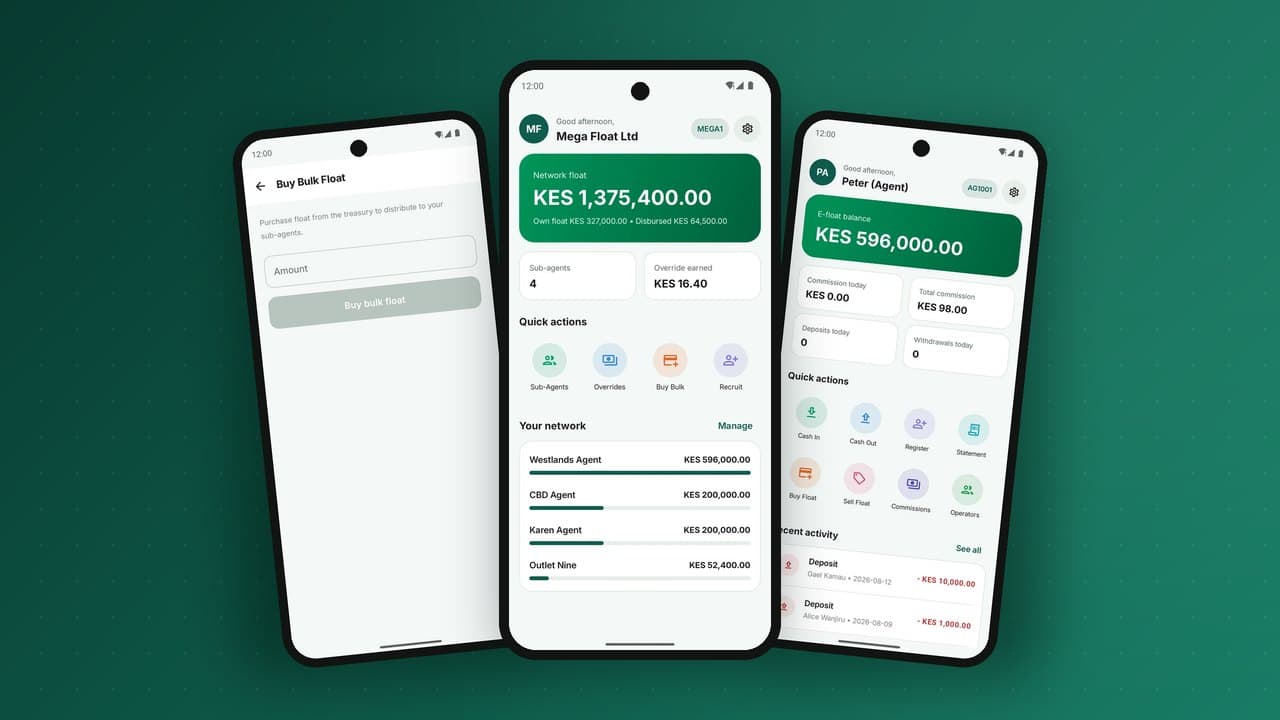
- Super-agents (aggregators or master agents) are larger businesses that recruit and manage many outlets. They buy float in bulk from the provider, often by bank transfer, and distribute it to their outlets. They typically earn an override commission, a share of what their outlets earn.
- Agent outlets serve customers.
The tree solves two problems. First, it pushes liquidity management down to someone with capital and a van: the super-agent moves cash and float between outlets that have too much of one and too little of the other. Second, it scales recruitment and supervision: the provider manages a few hundred aggregators instead of tens of thousands of shops.
Your platform needs to model the tree natively: parent-child relationships, float transfers down the tree, override commissions computed automatically, and reports at every level so a super-agent sees the health of each outlet.
Agent onboarding and due diligence
Regulators hold the provider responsible for its agents. A robust onboarding process includes:
- Application: business registration, owner ID, location and photos of the premises, ideally submitted through a self-service flow in the agent app or web portal.
- Due diligence: checks against sanctions lists and any internal blacklists, verification of the business and owner, and a site visit where required.
- Approval by compliance, with a recorded decision and reason.
- Training on transactions, KYC capture, fraud schemes and customer protection rules, such as displaying the official tariff.
- Activation with conservative limits, raised as the agent builds a track record.
Documents should route automatically to the compliance team, and every approval should be gated so no account can transact before it is approved. This is how you grow a network quickly without losing control of who is in it.
Agent limits and controls
Limits protect customers, the agent and the provider. A well-configured network sets:
- maximum transaction amounts for cash-in and cash-out;
- daily and monthly value limits per agent, raised with performance and tenure;
- maximum float balances, so a single compromised outlet cannot expose large sums;
- velocity rules that flag unusual patterns, such as many cash-outs of just-under-limit amounts;
- device binding, so the agent account works only on registered devices;
- operator (staff) logins for agents with several tellers, each with their own PIN and audit trail.
Agent fraud: the schemes to design against
Agents are the most exposed point in the network, both as victims and occasionally as perpetrators. The common schemes:
- Split transactions: an agent breaks one customer withdrawal into several smaller ones to earn more commission. Detect by grouping cash-outs by customer and agent within short windows.
- Direct deposits: instead of performing a cash-in to the recipient, the agent sends from their own float and pockets the customer's transfer fee, bypassing KYC and the fee schedule. Detect by patterns of agent-to-customer transfers.
- Unofficial fees: charging customers more than the published tariff. Counter with visible tariffs, SMS receipts showing the official fee, and mystery shopping.
- Impersonation of the provider: fraudsters calling agents and pretending to be head office to get them to "reverse" or "test" transactions. Counter with training and a rule that head office never asks for PINs or transfers.
- Stolen or borrowed IDs used to register accounts. Counter with photo capture, ID verification and limits on registrations per agent per day.
More in our full guide to mobile money fraud.
Measuring the health of an agent network
Registered agent counts are vanity. These are the numbers that tell you whether the network works:
| Metric | What it tells you |
|---|---|
| 30-day active agents (share of registered) | Whether your network is real or on paper |
| Transactions per active agent per day | Whether agents earn enough to stay |
| Average agent commission per month | Agent economics; compare to local shop margins |
| Liquidity failures (customers turned away) | The biggest driver of customer churn |
| Float days (float divided by daily cash-in) | Whether agents hold enough float |
| Customers within reach of an active agent | Coverage where it matters |
| Registrations per agent that become active | Quality of onboarding, and fraud signals |
A day in the life of an agent
It helps to picture the network from the counter. A typical agent in a busy town opens at 7 am and checks two numbers on the agent app: float balance and cash in the drawer. Morning traffic is mostly deposits from traders banking yesterday's takings and workers sending money home before work. By midday the float is running low, so the agent buys more from their super-agent through the app, paying with cash the super-agent's runner collects. Early afternoon brings a few customer registrations, each with ID capture and a first deposit, and a school bursar paying fees on behalf of parents. Late afternoon is withdrawals: people collecting money sent by relatives, casual workers cashing out daily wages. At closing, the agent checks the day's commission in the app, compares the expected cash with the drawer, and prints or views the day's statement.
Every friction in that day costs the agent customers: a slow transaction while a queue builds, a float purchase that takes an hour, a commission figure that does not match their own count. That is why agents judge a provider by its technology as much as by its commission rates.
Designing network coverage
Where you place agents matters as much as how many you recruit. Principles that work:
- Follow the flows of money: markets, bus stations, estates, farms that are paid in cash, and places where remittances arrive.
- Density before breadth: customers need an agent within a short walk, with a second option when the first is out of cash.
- Balance the mix: areas with heavy cash-out need some agents that naturally collect cash, such as busy shops, to recycle liquidity.
- Use the data: map active customers and transactions against agent locations to find gaps and oversupply.
- Prune inactive agents: an agent who never transacts is a compliance risk and a false comfort in coverage maps.
Agent banking for banks and microfinance institutions
Agent banking is not only for telcos. Banks and MFIs use agents to take deposits, disburse and collect loans, and open accounts in places where a branch would never be profitable. Several central banks have specific agent banking regulations for this, often with stricter rules than for e-money agents, such as requiring agents to be established businesses with a minimum trading history.
For a bank, the agent app becomes a thin branch: account lookup, deposit, withdrawal and loan repayment against the core banking system, with the same float and commission mechanics. The same platform can run both e-money agents and bank agents if its ledger and permissions are flexible enough.
How technology makes or breaks the network
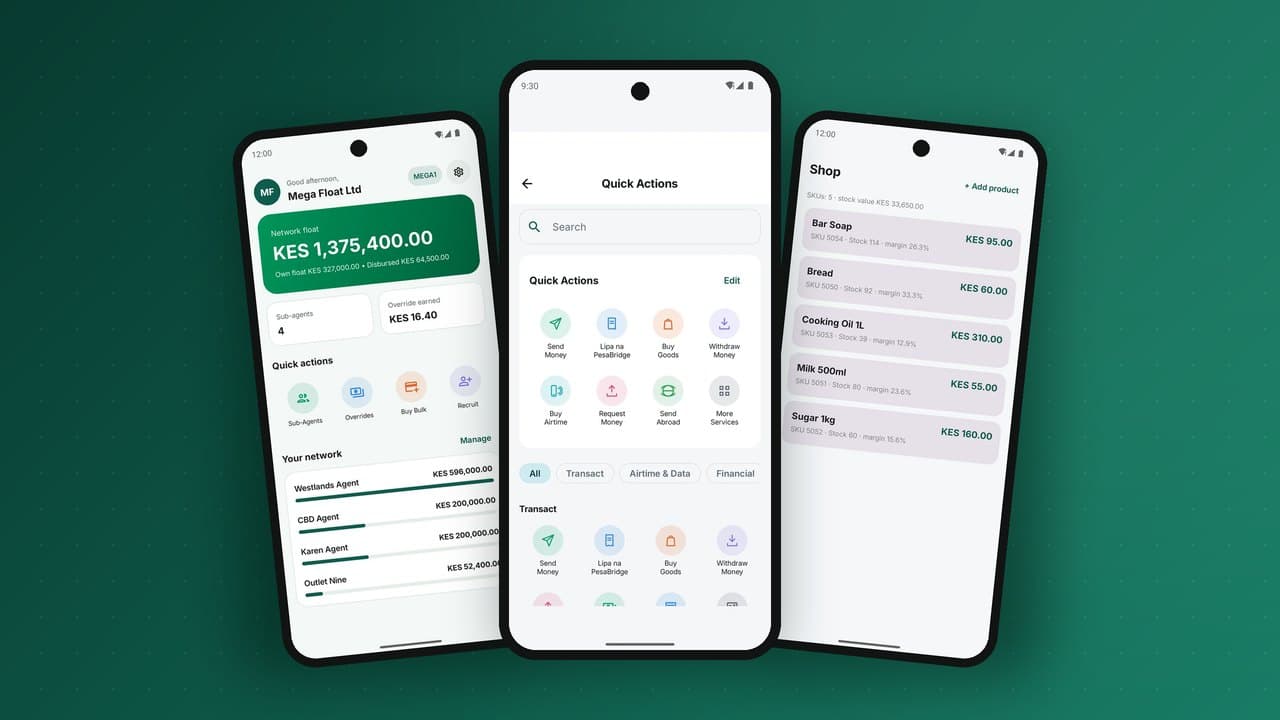
An agent will judge your service by three things: how fast a transaction completes while a customer waits at the counter, whether commission is exactly right, and whether they can see their float and cash position at a glance. A good agent platform provides:
- a fast native agent app, with a USSD fallback for when data is patchy;
- live float balance, daily cash position and commission earned today;
- buy-float and float-transfer flows, including from a super-agent;
- customer onboarding with document capture that works offline and syncs later;
- staff operators with their own logins under one agent account;
- statements and receipts that answer disputes without calling head office.
And behind it, the provider needs a back office that sees every agent, every limit, every alert and every commission, with the ability to adjust tariffs and commission rules without code.
What regulators typically require of agents
Agent regulations differ by country and by whether the principal is a bank or an e-money issuer, but most frameworks share common elements:
- Eligibility: agents must be established businesses, often with a minimum trading history and a registered premises, and must pass fit-and-proper checks.
- Principal liability: the bank or e-money issuer is responsible for its agents' conduct towards customers, so due diligence and monitoring are not optional.
- Permitted activities: a defined list, such as cash-in, cash-out, bill payments and account opening, with some activities reserved for bank agents.
- Customer protection: display of the official tariff and the principal's branding, receipts for every transaction, and a complaints channel.
- Transaction limits per customer and per agent, set by the principal within regulatory ceilings.
- Record keeping: transaction records and KYC documents retained for a set period.
- Reporting: periodic returns listing agents, their locations and activity, and notification of terminations.
- Exclusivity: many regulators prohibit exclusive agent contracts, so shops can serve several providers.
The practical implication: your platform must store agent records and documents, enforce limits, generate receipts, keep complete transaction histories and produce agent reports without manual effort. A network of thousands of agents cannot be governed from spreadsheets.
Common mistakes when building a network
- Recruiting for numbers. Thousands of dormant agents look good in a board pack and cost money in onboarding, branding and supervision. Measure active agents, not signed ones.
- Ignoring rural economics. Commission schedules designed for busy urban corridors leave rural agents unprofitable, and they quietly stop serving customers.
- No float plan. Agents who cannot rebalance turn customers away, and customers blame the brand, not the agent.
- Weak supervision. Without regular visits and data-driven monitoring, overcharging and fraud grow unnoticed.
- Treating agents as a channel, not a business. Agents who understand their earnings, see their statements and get training stay loyal and serve customers better.
Frequently asked questions
What is the difference between an agent and a super-agent?
An agent serves customers at a single outlet. A super-agent manages many outlets, distributes float to them, and earns an override commission on their activity.
Do agents need a bank account?
Usually yes. Agents need a way to buy float and to deposit excess cash, most often through a bank account or through their super-agent.
How much can an agent earn?
It depends on the tariff and transaction volume. Healthy networks aim for commission that is a meaningful addition to the shop's retail income, enough that holding float is clearly worth it.
Can one shop be an agent for several providers?
In many markets agent exclusivity is prohibited, so a shop can serve several providers. That makes agent experience and commission reliability a competitive advantage.
What happens if an agent runs out of cash?
The customer is turned away, and often does not come back. That is why liquidity management, through super-agents, bank partnerships and float alerts, is the core operational discipline of the network.
PesaBridge includes a native agent app and USSD for agents, float distribution through super-agent trees, automatic commission and override commission, self-service agent onboarding gated by KYC approval, transactions from the app, portal or USSD, and a back office to run the whole network. See the agent platform or request test access to try the agent app.