Launching a mobile money service is one of the most rewarding things a bank, telco, fintech or SACCO can do, and one of the easiest to get wrong. The app is rarely what decides success. Licensing, the trust account, agent distribution, the fee schedule and a ledger the regulator can audit decide it. This is a practical, step-by-step guide to launching a mobile money business in 2026: the decisions in the order you will face them, realistic timelines, and the mistakes we see most often.
Step 0: be honest about why you are launching
Every successful wallet solves a specific money problem for a specific group of people better than cash, banks or the incumbent wallet. Before you think about technology, write down the one sentence that explains why someone would move their money to you. Common winning answers look like this:
- A bank reaching customers where it has no branches, and turning them into depositors and borrowers.
- A telco monetising its subscriber base and dealer network, and reducing churn.
- A SACCO or microfinance institution letting members save, repay and borrow daily without travelling to an office.
- A fintech owning a corridor, a merchant segment or a gig-worker payout flow that incumbents serve badly.
- A retailer or distributor digitising payments across its own suppliers, shops and customers.
- A government programme paying benefits, subsidies or salaries without leakage.
Your answer drives everything that follows: which licence you need, where your first agents must be, which rails matter first and how you price.
Step 1: choose your regulatory route
Almost every central bank treats issuing e-money as a regulated activity. You typically have three routes:
| Route | Best for | Trade-offs |
|---|---|---|
| Your own e-money or payment service licence | Telcos, large fintechs, anyone planning to scale nationally | Capital requirements, governance, compliance staff, a longer approval process, full control |
| Operate under a bank's licence | Banks themselves; fintechs partnering with a bank | Faster start; the bank carries regulatory accountability and will want strong controls and a share of economics |
| Agent or sub-licence arrangement | SACCOs, MFIs and niche players | Lightest burden; less control over product and pricing |
Regulators will ask about safeguarding of customer funds, KYC and AML controls, agent due diligence, consumer protection, technology resilience, data protection and business continuity. Our overview of e-money licensing in Africa explains what reviewers look for and how to prepare your technology evidence.
Step 2: set up safeguarding and settlement banking
E-money must be backed one-to-one by funds in a trust or escrow account. You will need:
- A trust (or safeguarding) account at one or more banks, often split across banks to reduce concentration risk.
- Settlement accounts for moving money in and out: bank transfers, biller settlements, card and remittance partners.
- A daily reconciliation process proving that the sum of all wallets equals the trust balance. This is where a double-entry ledger pays for itself; see also reconciliation for wallets.
Open these conversations early. Bank onboarding for a new e-money issuer can take as long as the licence itself.
Step 3: design the product around weekly habits
Wallets die from inactivity, not from lack of features. Design your launch product around transactions people make every week:
- Send and receive money to any phone number, with the fee shown before confirming.
- Airtime and data bundles, the most frequent small transaction in most markets.
- Bills people already pay monthly: power, water, TV, school fees, rent.
- Merchant payments by till number, QR code or prompt-to-pay.
- Cash-in and cash-out close to home.
Savings, credit, insurance and international transfers come next, once customers trust you with their money. Every one of these should work on a basic phone over USSD as well as in the app; if your target customers are not all on smartphones, a USSD channel is not optional.
Step 4: build distribution before you launch
The agent network is the hardest asset to build and the easiest to underestimate. Customers will not deposit if there is no agent nearby to withdraw. Plan for:
- Agent recruitment. Shops, pharmacies, airtime dealers and existing bank agents. Aim for density in a few launch areas rather than thin national coverage.
- Super-agents and aggregators. Businesses that manage many outlets, distribute float and earn an override commission.
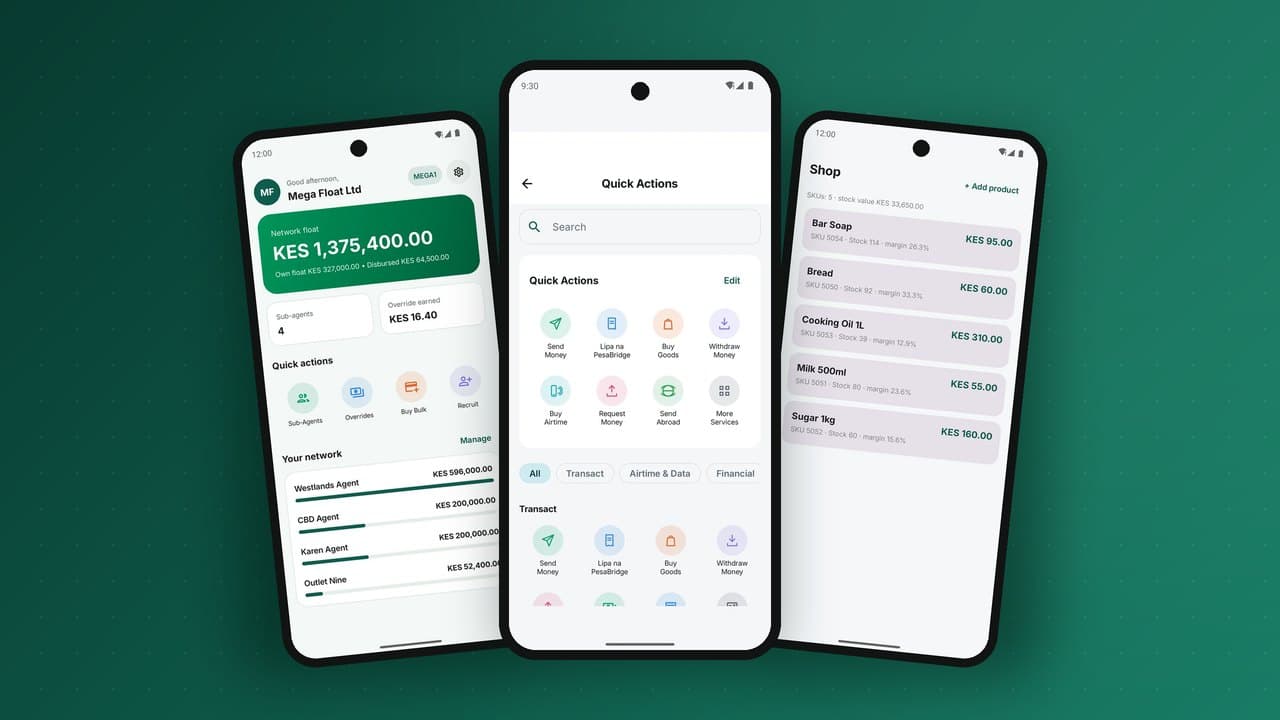
- Float management. Agents must hold enough cash and e-money to serve customers; running out is the most common reason customers abandon a wallet. See agent float and liquidity management.
- Training and support. A short, practical training and a support line that answers agents first.
- Merchants. Shops that accept wallet payments give customers a reason to keep money in the wallet rather than cash out immediately.
A self-service onboarding flow for agents and merchants, with documents routed to your compliance team for approval, lets you grow without a large field team.
Step 5: set a fee schedule that works for everyone
Pricing has three constituencies: customers, agents and you. A fee schedule that works typically:
- keeps deposits free or near-free to encourage cash-in;
- charges tiered fees for transfers and withdrawals, with low bands for the small amounts most people send;
- pays agents enough on cash-in and cash-out to justify holding float;
- keeps merchant fees below the cost of handling cash and below card acceptance;
- shows every fee before the customer confirms.
Model the economics per transaction type before launch: fee income minus agent commission, minus third-party rail costs, minus the share of fixed costs. Many wallets discover late that their most popular transaction loses money.
Step 6: choose your technology: build or white-label
This is the decision most teams spend the most time on, and it is the one with the clearest answer for most organisations. A production mobile money platform needs:
- a balanced, double-entry ledger with idempotency and a reversal engine;
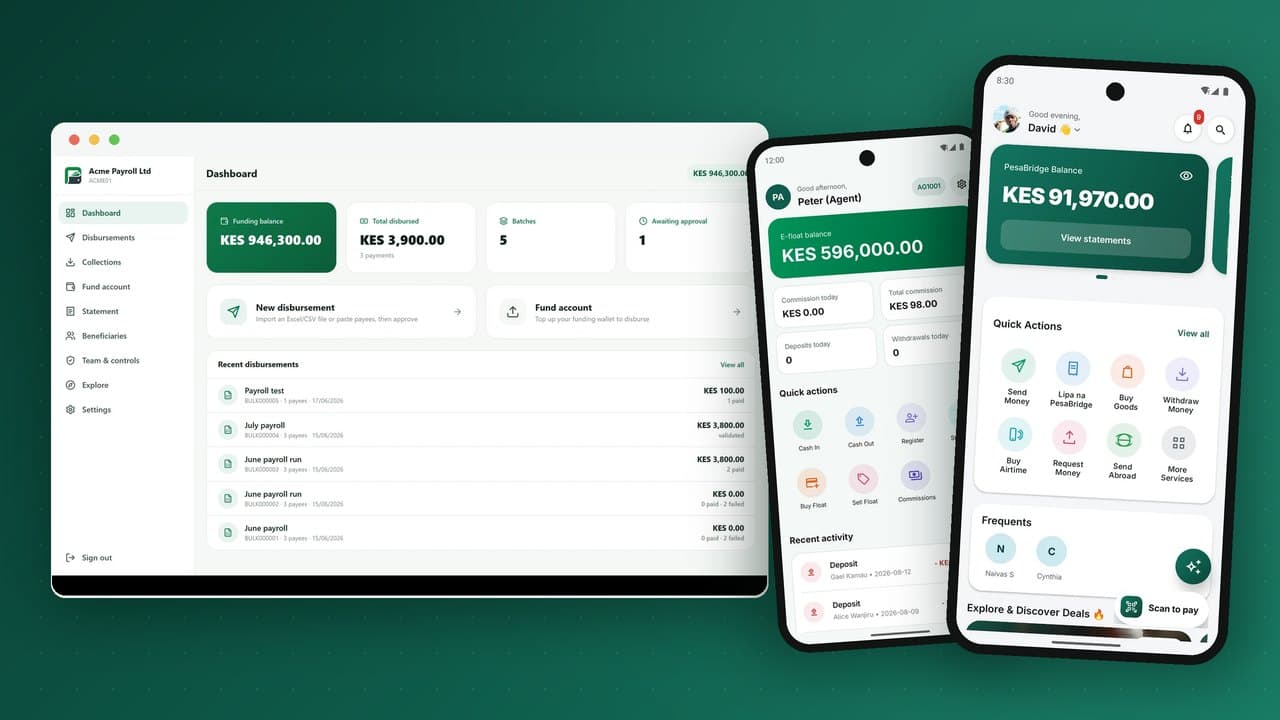
- customer, agent, merchant and corporate apps on Android (and often iOS);
- a USSD gateway and menu engine for feature phones;
- tiered KYC, limits, AML screening and case management;
- agent float, commissions and override commissions for super-agents;
- merchant tills, POS, settlement and end-of-day reports;
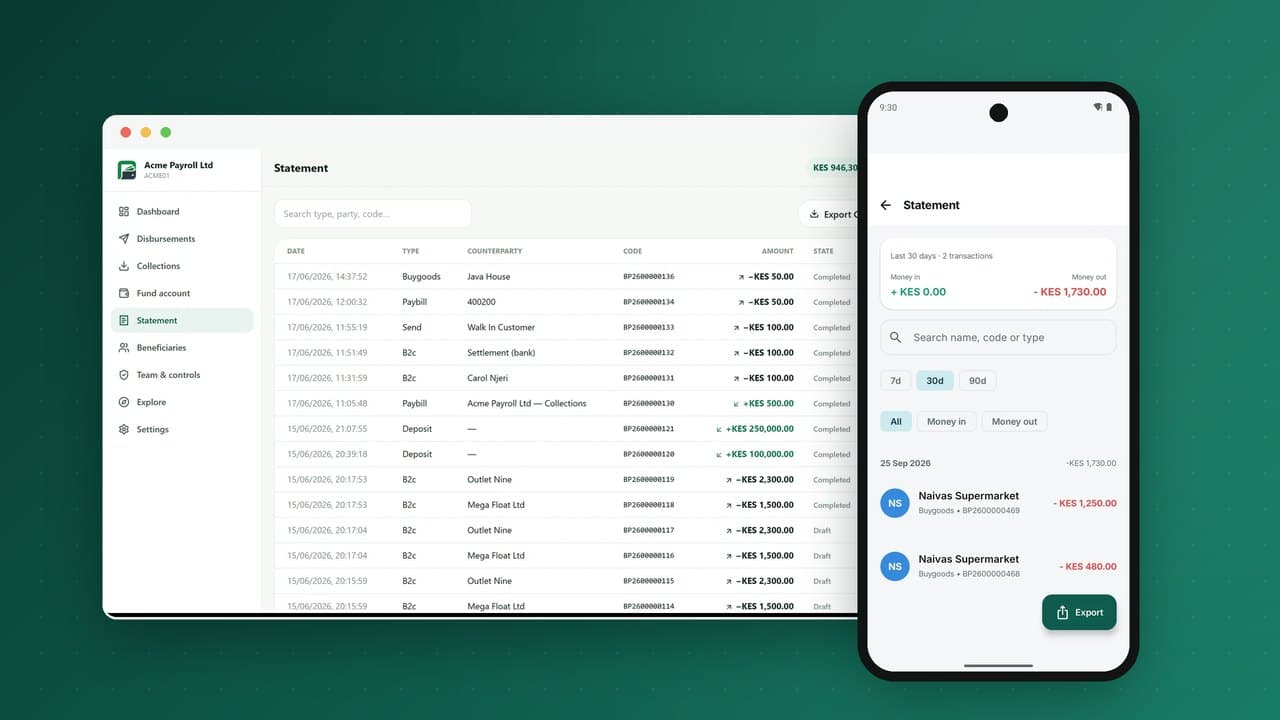
- bulk disbursements with maker-checker approval;
- integrations with banks, billers, airtime and other wallets;
- an API with signed webhooks for partners;
- a back office for operations, compliance and finance, with regulator-ready reporting.
Building all of this takes a strong team 12 to 24 months, and then you maintain it forever. A white-label platform gives you the same capabilities under your own brand, your own tenant and your own data, in weeks. The full comparison is in white-label vs. build. Whichever route you choose, insist on evidence: a live sandbox, real apps you can install, and a ledger demonstration showing balances that always sum to zero.
Step 7: pilot, then scale
A good pilot runs for eight to twelve weeks in one or two areas with a few hundred agents and merchants. Measure:
- Activity: share of registered customers transacting every 30 days (the metric that matters most).
- Agent liquidity: how often agents turn customers away for lack of cash or float.
- Transaction success rate and time to complete, per channel.
- Support contacts per thousand transactions, and their reasons.
- Unit economics by transaction type.
Fix what the pilot shows, then expand area by area. Scaling agents faster than customer demand, or customers faster than agent liquidity, are the two classic failure modes.
Step 8: stand up compliance operations, not just compliance policies
Regulators approve policies, but they supervise operations. From the first day of the pilot you need people and tools doing the work every day:
- KYC review. A queue where agents' and customers' documents are checked and approved, with clear reasons for rejection and a re-submission path. Tiered KYC lets low-risk customers start with a phone number and a basic ID while higher tiers unlock bigger limits; see KYC tiers a regulator accepts.
- Transaction monitoring. Rules that flag unusual velocity, round-amount structuring, many senders to one receiver, dormant accounts that suddenly move large sums, and agents with abnormal patterns. Every alert needs an owner and a documented outcome.
- Sanctions and PEP screening at onboarding and on a schedule afterwards.
- Suspicious transaction reporting to the financial intelligence unit within the legal deadline.
- Regulatory returns. Periodic reports on customers, agents, transaction volumes and values, trust account balances and complaints, usually in a format the central bank defines.
The practical test is simple: if the regulator asks "show me every alert raised last month and what you did about each one," can you answer in minutes? If the answer lives in email threads and spreadsheets, fix it before you scale.
Step 9: design customer support and dispute handling
Money that goes to the wrong number is the most common support case in every mobile money service. Plan for it explicitly:
- A reversal process with clear rules: when the recipient has not spent the money, when they have, and when the sender needs to involve the police. Nothing should ever be deleted; a reversal posts mirror entries so the original transaction stays intact for audit.
- Self-service answers for the top questions: fees, limits, PIN reset, how to reverse. An in-app assistant that answers in plain language takes a large share of contacts off the call centre.
- A PIN reset flow that is secure (ID verification, a cooling-off period on large withdrawals afterwards) but does not require a branch visit.
- Agent support first. A stuck agent affects dozens of customers a day; give agents a priority line.
- Complaint tracking with time-to-resolution metrics, because regulators increasingly supervise consumer outcomes, not just capital.
Step 10: drive activation, not registration
Registrations are easy to buy and meaningless on their own. What matters is how many customers transact every month. The activation levers that work consistently:
- A first transaction at sign-up. Walk every new customer through a small cash-in and an airtime purchase at the agent before they leave.
- Salary and payout flows. A single employer, cooperative or gig platform paying into wallets can bring thousands of active users at once. See bulk payments to wallets.
- Merchant acceptance near where people live. Money that can be spent in the wallet stays in the wallet.
- Group savings. Chamas and savings groups create weekly, social transactions. See digital chamas.
- Referral rewards paid on first real use, not on sign-up, so you pay for active customers.
The integration checklist for launch
Before the pilot starts, confirm each of these connections works end to end in production, with reconciliation files matching:
| Integration | Why it matters | What to test |
|---|---|---|
| Safeguarding and settlement banks | Money in and out; proof that e-money is backed | Daily statement import and automatic matching |
| USSD aggregator or MNO gateways | Reach on basic phones | Session timeouts, menu speed, PIN masking |
| SMS gateway | Receipts and one-time codes | Delivery rates per network, sender ID |
| Airtime and bundle providers | The most frequent transaction | Failures and automatic refunds |
| Billers | Monthly habits | Account validation before payment, biller settlement |
| Bank transfers and other wallets | Customers expect to move money anywhere | Pending states, timeouts, reversals |
| Identity verification | KYC at scale | ID lookup response times and fallbacks |
| Partner API and webhooks | Merchants and platforms integrating | Signed callbacks, retries, idempotency keys |
A realistic timeline
| Phase | Typical duration | Key outputs |
|---|---|---|
| Strategy and business case | 4 to 8 weeks | Target segment, product, fee model, P&L |
| Licensing or partner agreement | 3 to 12 months (varies by country) | Licence or bank partnership, safeguarding account |
| Technology setup (white-label) | 4 to 8 weeks, in parallel | Branded apps, USSD code, back office, integrations |
| Agent and merchant recruitment | 8 to 12 weeks before launch | Trained, liquid agents in launch areas |
| Pilot | 8 to 12 weeks | Activity, liquidity and economics data |
| Scale | Ongoing | New areas, new products, new rails |
Technology and licensing should run in parallel. Regulators usually want to see a working platform during review, and a sandbox with real apps is powerful evidence.
Seven mistakes that sink new wallets
- Launching without agent liquidity. A customer who cannot withdraw once rarely deposits again.
- Treating USSD as an afterthought. In most markets a large share of customers are on basic phones.
- A ledger that cannot prove itself. Balances that drift from the trust account are a regulatory incident waiting to happen.
- Pricing copied from the incumbent. Your cost base and strategy are different; model your own economics.
- Too many features, too little habit. Ten products used monthly lose to three used weekly.
- Ignoring fraud until it happens. Social engineering and SIM-swap fraud arrive within weeks of launch. See fraud prevention.
- Manual reconciliation. Spreadsheets at month-end do not survive scale.
Frequently asked questions
How much does it cost to start a mobile money business?
The largest costs are regulatory capital (if you hold your own licence), agent recruitment and float support, marketing and staff. Technology on a white-label platform is usually a smaller, predictable line compared with building and maintaining your own.
Can a SACCO or microfinance institution launch a wallet?
Yes. Many do so under a partner bank or an existing licence. The wallet lets members deposit, repay and borrow daily, and it reduces cash handling at branches.
Do I need my own USSD short code?
If your customers use basic phones, yes. You obtain the code through the telecom regulator and connect it via an aggregator or directly with mobile network operators.
What team do we need at launch?
A small core: a product owner, an operations lead for agents and merchants, a compliance officer with KYC and monitoring analysts, a finance lead for reconciliation, customer support, and a technical lead who owns integrations. On a white-label platform you do not need a large engineering team to run the core.
Should we launch on Android only, or iOS too?
In most African markets Android dominates smartphones, and USSD covers basic phones. Launch with Android and USSD, and add iOS when your customer mix justifies it; web portals serve businesses on any device.
How long until a new wallet breaks even?
It depends on activity, fee levels and agent costs. The metric to watch is monthly active customers per agent and revenue per active customer, not registrations.
Planning a launch? PesaBridge gives you the whole platform under your brand: customer, agent, merchant and corporate apps, USSD, prompt-to-pay, bulk payouts and an open API on a double-entry ledger. Request test access to try every app this week, or talk to our team about your market.