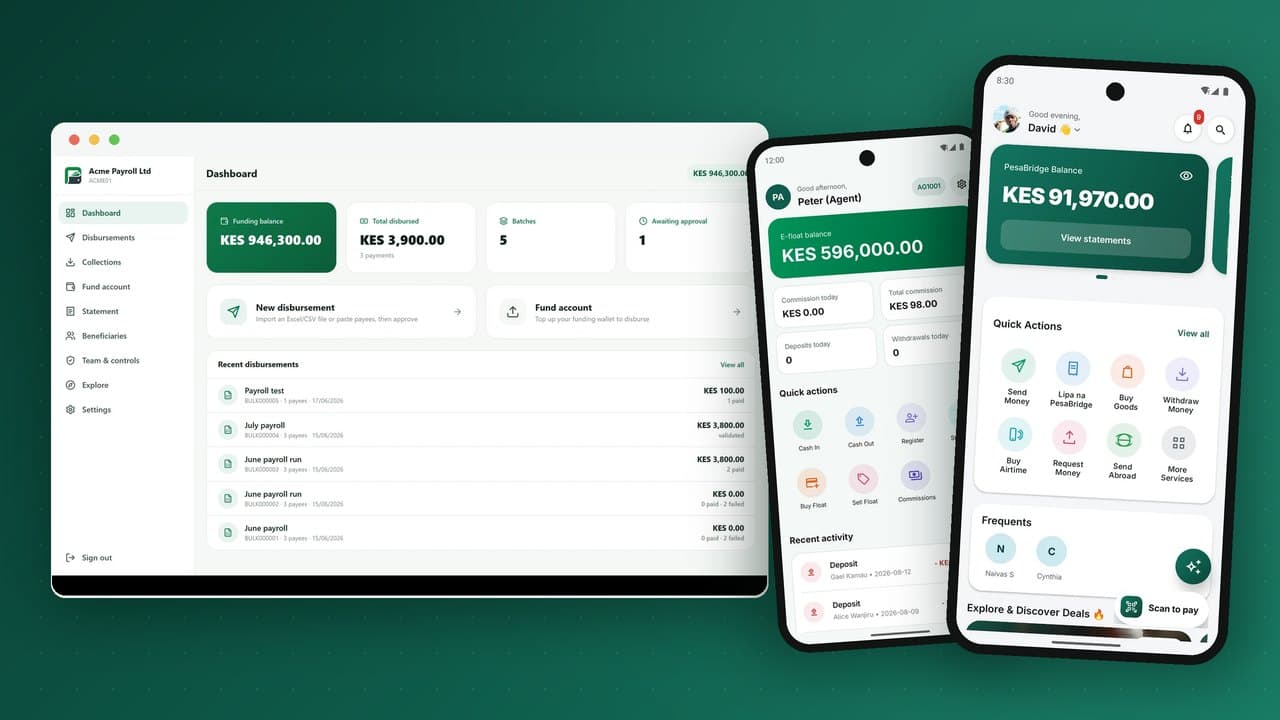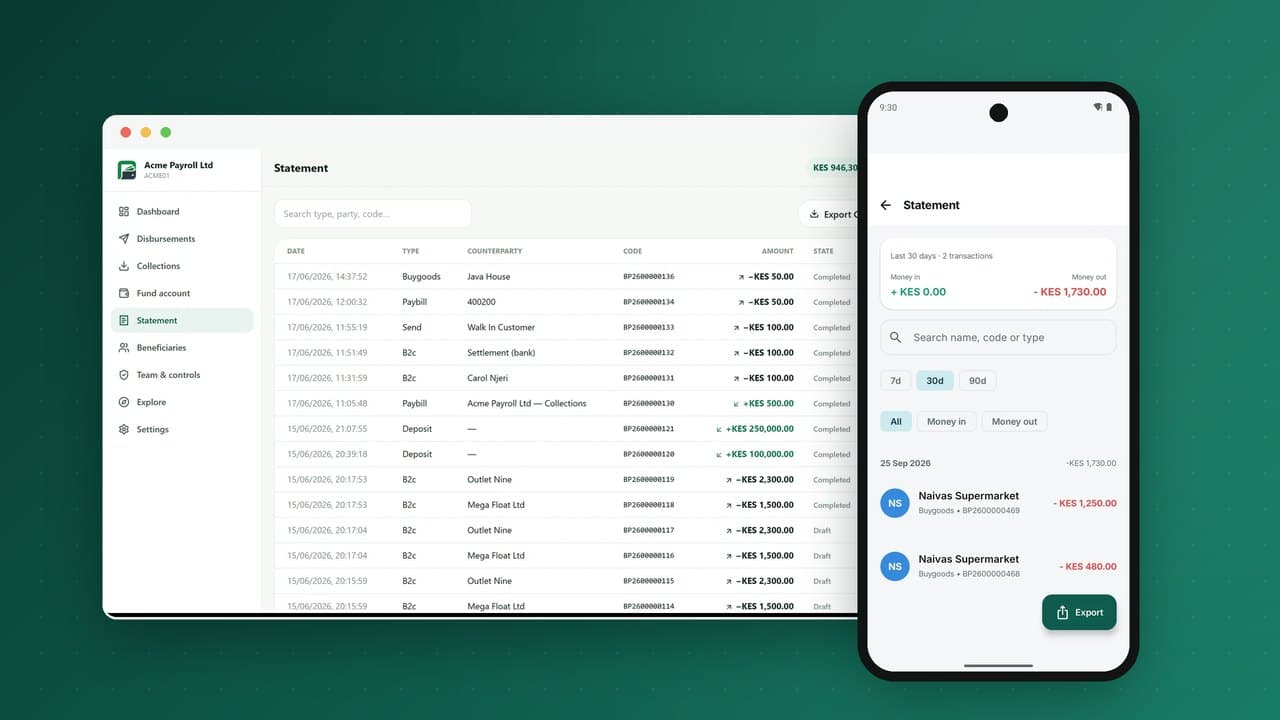
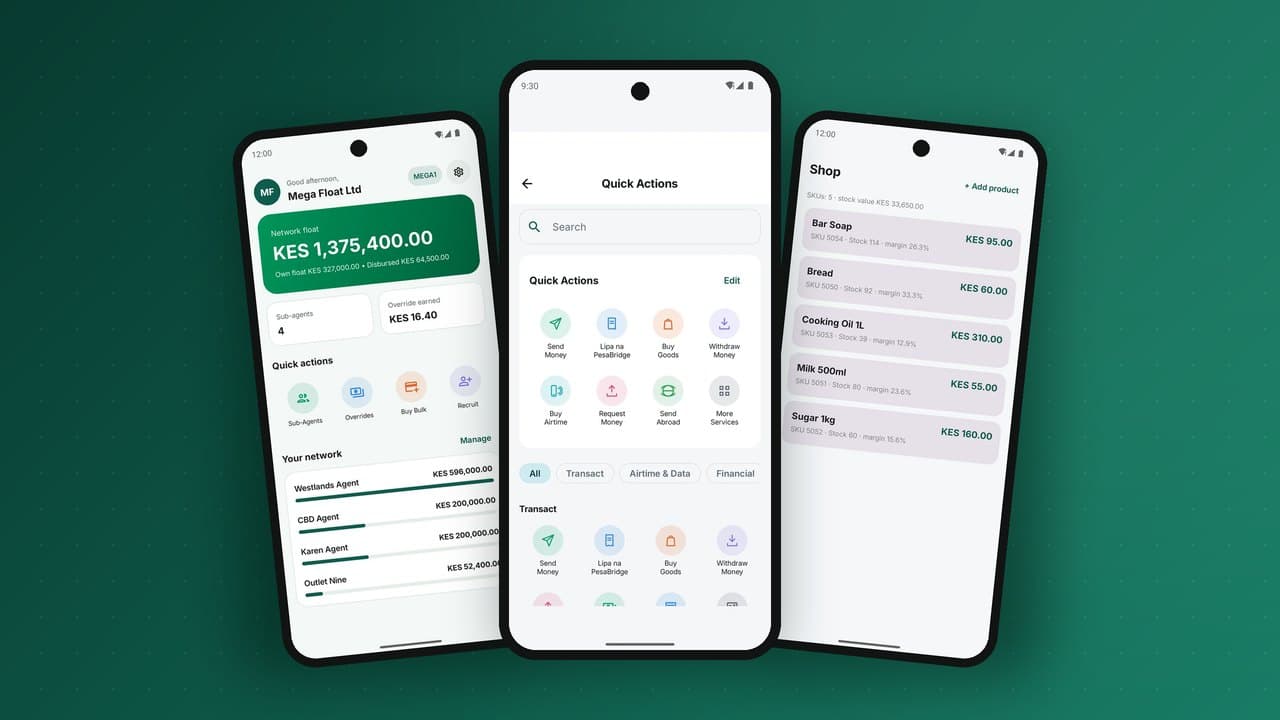
Every team that sets out to build a wallet starts in the same place: a screen. A balance, a Send button, a list of recent transactions. It demos beautifully in a week, and it convinces everyone in the room that a mobile money platform is a few sprints away. It is not. The screen is the thinnest possible slice of the problem, and the moment real money flows behind it, the iceberg under the waterline is what decides whether you launch, and whether you keep your licence after you do.
This is the most consequential decision an operator makes before launch — build the core yourself or white-label a proven one — and it is almost always made on instinct rather than arithmetic. Below is the arithmetic.
What you are actually buying when you buy "a wallet"
A mobile financial services platform is not an app. It is a small clearing system that happens to have apps attached. To go live and stay live, you need every one of the following working together, reconciled to the cent, and defensible in front of a regulator:
- A double-entry ledger with idempotency, a reversal engine, and pre-flight balance and limit checks — the financial heart that can never drift.
- An agent and float network: cash-in and cash-out, commission structures, float distribution down a hierarchy, and daily reconciliation that actually balances.
- A merchant layer: till numbers, Pay Bill, QR acceptance, prompt-to-pay, and scheduled settlement to a bank.
- A USSD gateway and menu engine so the wallet runs on a feature phone with no app and no data.
- KYC tiers, limits and AML controls a central bank will sign off on — sanctions and PEP screening, velocity rules, an immutable audit trail.
- Four native apps across two platforms — consumer, agent, merchant, corporate — plus their upgrades, store reviews and security patches, forever.
- A developer API with OAuth2, webhooks, signing, and the documentation partners need to integrate.
- Settlement and reconciliation to banks, mobile money operators, card processors and billers — each a different protocol with a different failure mode.
Notice what is missing from that list: anything that differentiates your business. None of it is where you win. It is all table stakes — the cost of being allowed to play at all.
Where the schedule actually goes
Teams budget for the visible surface and underestimate the clearing system beneath it by an order of magnitude. The classic plan allocates most of the timeline to apps and a small buffer to "the backend." In practice the order reverses. The ledger, the reconciliation engine and the compliance layer are where the months disappear, because they are the parts that have to be correct, not merely functional.
There is a useful rule of thumb here. The first 80% of a payments backend — the happy path — takes a quarter of the time. The remaining 20% — retries, partial failures, reversals, disputes, the reconciliation that has to tie out at 2 a.m. — takes the other three quarters. It is precisely the work that does not demo, so it is precisely the work that is under-planned.
The app is the easy part. The hard part is everything a customer never sees and a regulator never forgets.
The team you actually need
The cost conversation usually fixates on engineering salaries and stops there. The real org chart for a from-scratch build is wider:
- Ledger and core engineers who have built financial systems before and understand idempotency, concurrency and reconciliation in their bones. These people are rare and expensive, and hiring the wrong ones is worse than not hiring at all.
- Mobile engineers for four apps on two platforms, plus the long tail of OS upgrades, device fragmentation and store compliance.
- A compliance and risk function that can translate central-bank regulation into enforceable product rules — and defend them in an audit.
- SRE and security for a system that must be up when people need cash, and that is now a target the moment it holds real value.
- Integrations engineers for every bank, mobile money operator, card processor and biller — each with its own sandbox, certification and quirks.
That is a standing team, not a project team. It does not disband at launch; it grows, because once you are live you are also running an operation that never stops.
The hidden costs nobody lines up for
The build-vs-buy spreadsheet usually compares a licence fee against salaries and declares the build cheaper. It misses four costs that dominate the real total:
- Time-to-market. Twelve to twenty-four months of not being in the market is not a neutral delay — it is revenue you never earn and a competitor's head start you can never recover. In a land-grab market, this is usually the single largest number in the model, and it is the one most often left out.
- The maintenance tail. A platform is not finished at launch; that is when its real cost begins. Regulations change, OSes update, rails deprecate APIs, security advisories land on a Friday. The team that built it is now the team that must keep it alive — forever.
- Correctness risk. A reconciliation bug discovered a week after launch is not a bug; it is a crisis of trust. The expected cost of getting the ledger subtly wrong — the reputational and regulatory damage — should be priced in, and almost never is.
- Opportunity cost. Every senior engineer rebuilding a ledger is an engineer not building the thing only you can build: your distribution, your pricing, your product edge.
So when does building actually make sense?
This is not an argument that nobody should ever build. It is an argument for honesty about why. Building your own core is the right call in a narrow set of cases:
- The ledger and money movement are themselves your core differentiator and moat — a novel settlement mechanism, not a standard wallet.
- You have already assembled and retained a team that has shipped clearing-grade systems, and you can keep them for the lifetime of the platform.
- Your regulatory or data-residency constraints are so unusual that no existing platform can meet them — genuinely rare, and usually solvable with deployment options rather than a rebuild.
If none of those is unambiguously true, the build is a decision to spend your scarcest resource — senior engineering time and calendar months — on a problem that has already been solved, hardened and reconciled by someone else.
A worked comparison: two operators, one market
Imagine two operators with the same licence ambitions entering the same market in the same month. One builds; one white-labels. The figures below are illustrative, drawn from the ranges operators commonly report, but the shape is consistent.
| Workstream | Build your own core | White-label a proven core |
|---|---|---|
| Ledger, limits and reversals | 6–12 months to production grade | Configured in days; already running elsewhere |
| Agent and float engine | 4–8 months, then tuning in the field | Configure commissions and hierarchy |
| Apps (customer, agent, merchant, corporate) | 6–12 months for four apps | Rebrand and publish |
| USSD channel | 3–6 months plus gateway certification | Connect the gateway |
| Integrations (banks, billers, rails) | Each one a project | Existing adapters, new ones as needed |
| Team you must retain | Core, mobile, compliance, SRE, integrations | Product, operations, distribution |
| Typical time to first live customer | 12–24 months | Weeks after the licence allows it |
The table hides one more difference. The builder reaches launch with software that has never met real customers. The white-labeller launches on software that has already been through its first thousand bugs somewhere else. The second advantage is harder to price and often matters more.
The licence clock runs either way
A common objection is that the licence takes a year anyway, so the build can happen in parallel. There is some truth in it: regulatory approval sets a floor on your timeline whatever you choose. But the argument misses two things. First, regulators increasingly want to see the technology working before they approve, not a promise that it will exist. A platform you can demonstrate, with limits, audit trails and reports running, shortens the review; a slide deck lengthens it. Second, the licence is not the finish line. The months after approval are when you recruit agents, pilot, fix, and scale. An operator who spends them still building is competing with operators who spend them selling.
What white-label actually changes
White-labelling a proven core flips the equation from build the engine to run the business. You configure your brand, country, currency, channels, commissions and limits, and you spend your time on the things that actually decide whether you win: go-to-market, agent recruitment, pricing, distribution and partnerships. The ledger, the agent engine and the compliance layer already exist, already balance, and are already running on live deployments under other brands.
The objection — "but then it's not really ours" — misunderstands what ownership means here. You own the brand, the customer relationship, the data, the pricing and the economics. What you are choosing not to own is the undifferentiated plumbing, in exactly the way that no serious company writes its own database engine to run a SaaS product.
A useful way to frame the decision: list everything in the platform, and for each part ask one question — does building this myself change whether a customer chooses me? For the ledger, the USSD gateway and the reconciliation engine, the honest answer is no. For your distribution, your brand and your market strategy, the answer is yes. Build the second list. Buy the first.
Questions to ask any white-label provider
If you decide to white-label, the choice of provider is the new big decision. These questions separate platforms you can build a business on from demos with a contract attached:
- Is the ledger double-entry, and can you show me a reconciliation? Ask to see the daily close, not a diagram of it.
- Where does my data live, and who controls it? Per-operator deployments keep customer data with the licensed entity; shared multi-tenant databases raise questions a regulator will ask.
- What happens to my limits and rules on every channel? They should be enforced in one place, the core, not re-implemented in each app.
- Which channels are live today? App, USSD, web and API should run against the same ledger; ask to see each one working.
- How do integrations get added? Existing adapters matter less than a clear, repeatable way to add the next bank or biller.
- What can I configure without the vendor? Fees, commissions, limits, branding and content should be operator-controlled.
- How are upgrades delivered? You want improvements without migrations that put your live service at risk.
- What evidence will you give my regulator? Security documentation, audit logs, test results and architecture descriptions should be ready, not written on request.
- How do I leave? The answer tells you how the vendor thinks about your business.
Avoiding lock-in
The fair worry about any white-label decision is dependency. You can reduce it contractually and technically. Contractually, agree data ownership explicitly, set service levels with remedies, and define an exit process with data export in a usable format. Technically, keep your own copies of what defines your business: customer records, transaction history, fee schedules, agent hierarchy and reports. A platform built on a clean ledger makes this easy, because every balance can be reconstructed from the entries. The goal is not to plan for leaving; it is to make sure you never stay only because leaving is impossible.
The hybrid path: buy the core, build the edge
White-labelling the core does not mean giving up engineering. The best operators put their engineers exactly where differentiation lives: the partner integrations that are unique to their market, the analytics that drive their agent strategy, the mini-apps and services that make their wallet stickier, the credit models that fit their customers. A platform with a documented developer API, webhooks and a way to add services on top lets you build that edge without touching money movement. Your engineers then spend their time on the work that customers notice, on top of a core that regulators trust.
The first 90 days after choosing
Once the decision is made, the fastest operators run three workstreams in parallel rather than one after another:
- Configuration. Brand, currency, fee schedule, commission plan, KYC tiers and limits, agreed with finance and compliance and loaded into the platform in a test environment.
- Regulatory evidence. Architecture, security, data protection and business continuity documents assembled from the provider's material and your own policies, with screenshots and reports from the running system.
- Distribution. The first agents and merchants recruited, trained on the test apps, and ready to go live on the same day as customers, so nobody opens a wallet with nowhere to use it.
At the end of the ninety days you should have a working pilot environment, a complete licence file and a launch network. The technology is rarely the bottleneck by then, which is exactly the point of choosing a proven core.
Frequently asked questions
Is white-labelling only for small operators?
No. Large banks and telcos white-label for the same reasons small ones do: speed, proven correctness and a smaller standing team. What changes with size is the deployment model and the depth of integration, not the logic of the decision.
Can we move to our own core later?
Yes, if you plan for it: own your data, keep export paths open, and design your own services against the API rather than the internals. Many operators find that once live, they would rather invest in distribution than rebuild a working core.
Does white-label mean every operator's app looks the same?
It should not. Brand, colours, content, services, fees and channels are yours to configure. What is shared is the engine underneath, in the same way that different banks can run on the same core banking system.
How long does a white-label launch really take?
The technology can be configured and branded in weeks. The overall timeline is usually set by licensing, bank and partner agreements, and recruiting the first agents and merchants, which is why those workstreams should start on day one.
This is the bet PesaBridge is built on: one hardened core, your brand on top, live in weeks rather than years — so the months you would have spent rebuilding clearing infrastructure go into the only work that actually compounds for you.