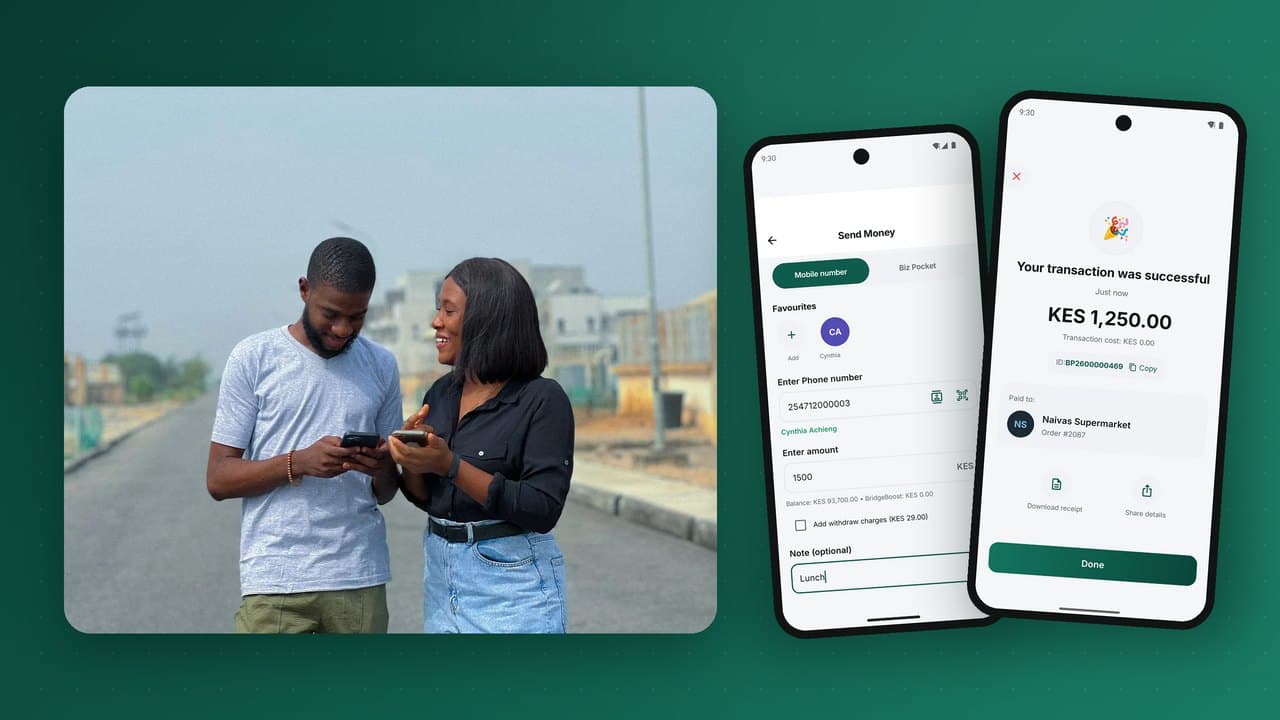
Mobile money is a way to store, send and receive money using a mobile phone number as the account, without needing a bank account or a smartphone. It started in East Africa, it now moves well over a trillion dollars a year across emerging markets, and it has quietly become the most successful financial-inclusion technology ever deployed. This guide explains what mobile money is, how it actually works underneath, who runs it, how it makes money and what it takes to launch one in 2026.
Mobile money in one paragraph
A mobile money account is an electronic wallet tied to a phone number. The balance is e-money: a digital claim on real money that the provider holds in trust at one or more banks. Customers turn cash into e-money at an agent (a shop, kiosk or pharmacy), then use that balance to send money to anyone with a phone number, pay bills, buy goods at shops, top up airtime, save and borrow. When they need cash again, an agent pays it out. The whole experience runs on a basic phone over USSD, on a smartphone app, or both.
That is the entire idea. What makes it powerful is that each piece removes a barrier that kept hundreds of millions of people outside the formal financial system: no branch to travel to, no minimum balance, no paperwork beyond an ID, and a device people already own.
A short history: from airtime to a financial system
Before mobile money, people in many markets already used airtime as informal currency, sending top-up vouchers to relatives who would sell them for cash. Mobile money formalised the behaviour. The best-known launch was M-Pesa in Kenya in March 2007, run by Safaricom. It began as a simple "send money home" service for urban workers supporting families upcountry, and within a few years a majority of Kenyan adults were using it.
The model spread across East, West and Southern Africa, then to South and Southeast Asia and Latin America. According to the GSMA's annual State of the Industry reports, there are now more than 1.7 billion registered mobile money accounts worldwide, roughly half of them in Sub-Saharan Africa, and the value moving through them each year runs well into the trillions of dollars. The World Bank's Global Findex data shows the same story from the customer side: in Sub-Saharan Africa, a third of adults had a mobile money account by 2021, and in several countries mobile money accounts outnumber bank accounts.
The services also grew far beyond person-to-person transfers. Today a single wallet typically offers bill payment, merchant payments, savings, credit, insurance, international remittances, salary payments and payments to and from government.
How mobile money works under the hood
From the outside mobile money looks like a balance and a send button. Underneath it is a small clearing system. Five building blocks do the work.
1. The e-money float and the trust account
Every unit of e-money in customers' wallets must be backed one-to-one by real money held in a regulated trust or escrow account at a bank. If customers hold a combined 100 million in their wallets, the provider must hold 100 million in trust. This is the single most important rule in mobile money: it is what makes e-money safe, and it is what regulators check first. The provider cannot lend that money out or use it to run the business.
2. The ledger
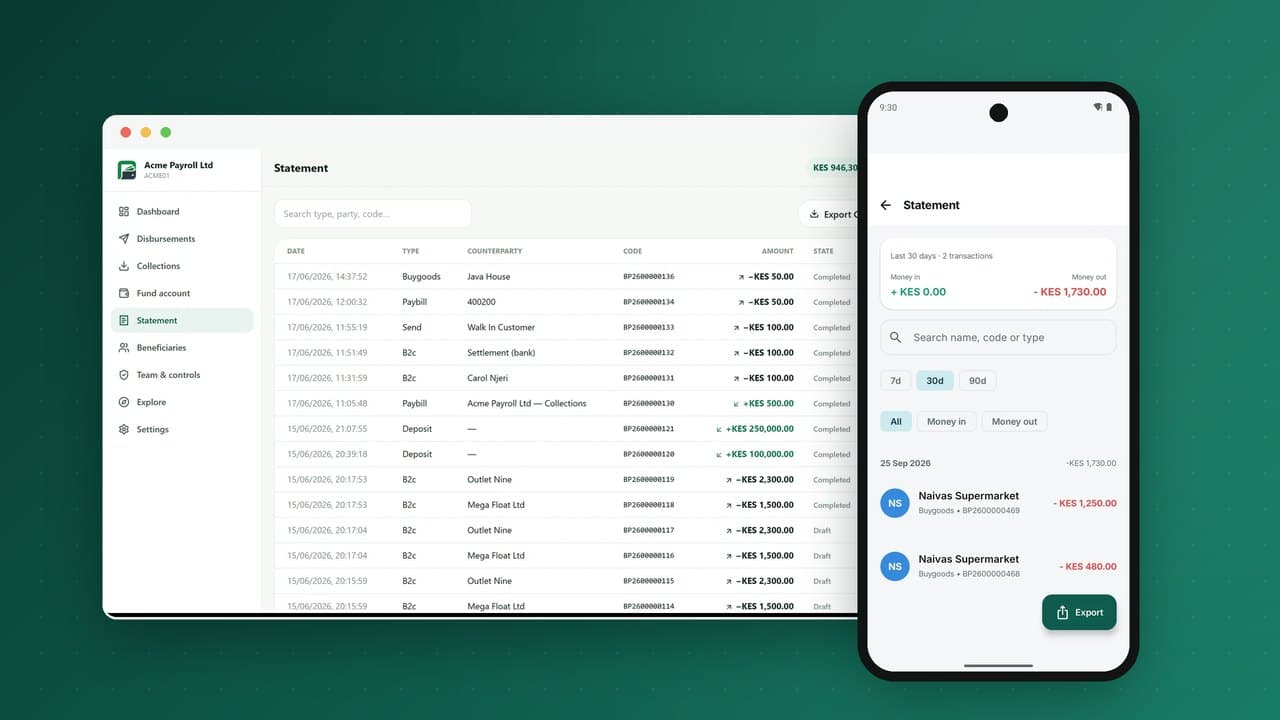
The ledger is the record of who owns what. Every movement, whether a transfer, a fee or a cash-out, is recorded as balanced entries: money leaves one account and arrives in another, and the total never changes. A well-built mobile money ledger is double-entry, meaning every debit has a matching credit and the books always sum to zero. This is how the provider can prove at any moment that the total of all wallets equals the money held in trust.
3. The agent network
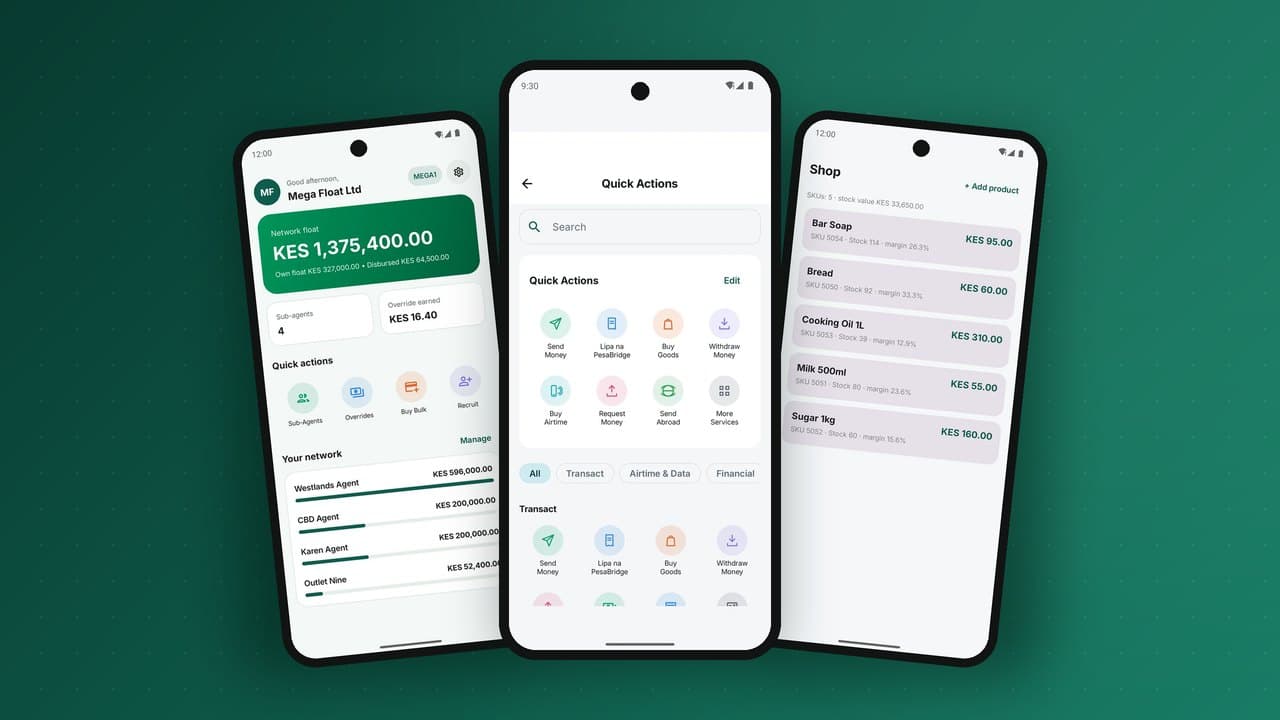
Agents are the physical edge of the system. An agent keeps two stocks of value: physical cash in the drawer and e-money in an agent wallet (the "float"). When a customer deposits cash, the agent takes the notes and transfers e-money from the agent's float to the customer. When a customer withdraws, the reverse happens. Agents earn a commission on each transaction. Without agents, mobile money cannot bridge the cash economy, which is why the size and health of the agent network usually decides whether a service succeeds. We cover this in depth in our guide to agent banking.
4. Channels: USSD, SIM toolkit and apps
Customers reach their wallet through one or more channels:
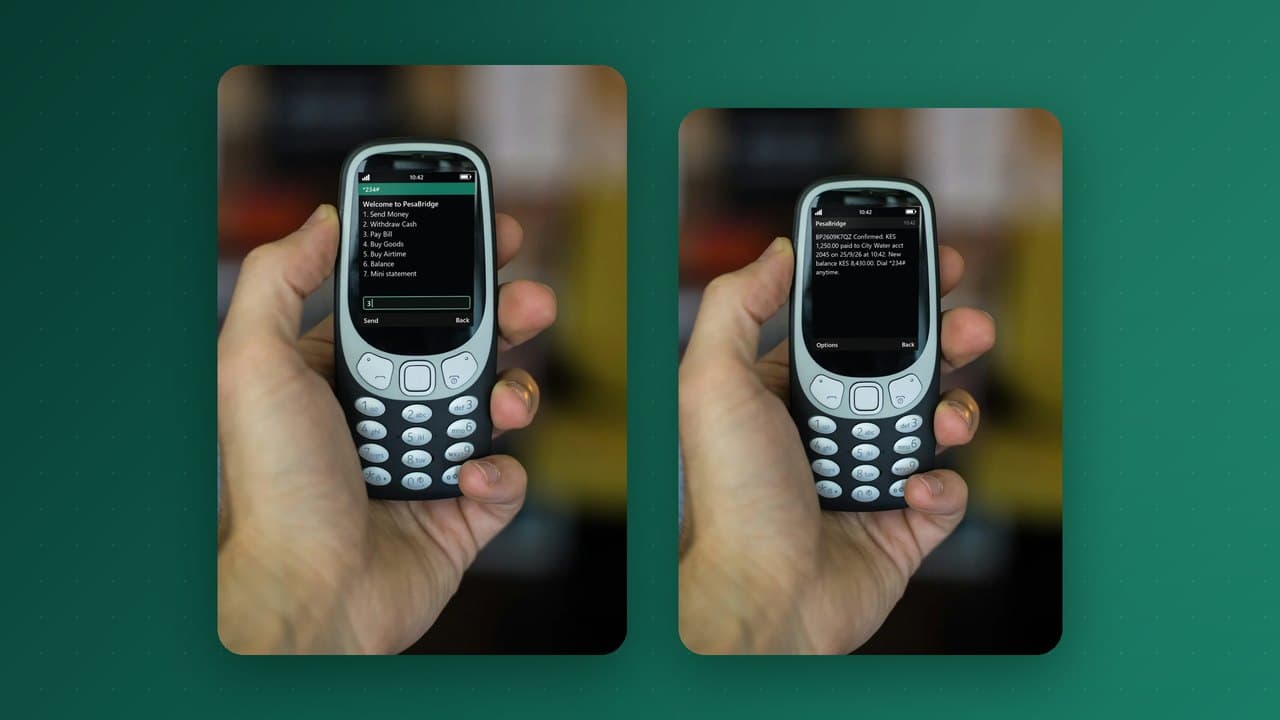
- USSD: the menus you open by dialling a short code like *123#. It works on every phone, needs no data, and is still the main channel in many markets. See how USSD reaches the feature phone.
- SIM Toolkit (STK): a menu stored on the SIM card, used by some operators for secure PIN prompts on basic phones.
- Smartphone apps: richer screens, QR payments, statements, savings goals and mini-apps.
- Web and APIs: portals for businesses and programmatic access for partners who want to collect or pay out.
5. Rails and integrations
A wallet becomes useful when it connects to everything else: banks (to move money in and out), billers (power, water, TV, school fees), airtime systems, card networks, other mobile money providers and international remittance partners. Each connection is a "rail." Good platforms treat rails as plug-in adapters so a new bank or biller can be added without touching the core ledger.
What customers actually do with mobile money
| Use case | What happens | Why it matters |
|---|---|---|
| Person-to-person transfer | Send to any phone number; the recipient gets an SMS and the balance instantly. | Replaces bus trips carrying cash and informal couriers. |
| Cash-in and cash-out | Deposit or withdraw cash at an agent. | Connects the wallet to the cash economy. |
| Bill payment | Pay a utility or school using a business number and account reference. | No queues at offices; instant, reconciled receipts for the biller. |
| Merchant payment | Pay a shop by till number, QR code or a prompt sent to the phone. | Less cash handling and theft risk for small businesses. |
| Airtime and bundles | Top up your own or someone else's line. | The everyday habit that keeps wallets active. |
| Savings and credit | Lock savings, join group savings, borrow small amounts. | Builds financial history for people with no bank record. |
| Salaries and disbursements | Employers, NGOs and governments pay thousands of wallets at once. | Faster, auditable payments with less leakage. |
| International remittances | Receive money from abroad straight into the wallet. | Cheaper and faster than collecting cash at a counter. |
Who runs mobile money services?
Mobile money was pioneered by mobile network operators, and telcos still run many of the largest services. But the field is much broader now:
- Mobile network operators (MNOs) own the SIM, the USSD channel and a large retail footprint of airtime dealers who can become agents.
- Banks run their own wallets to reach customers they could never serve through branches, and to capture deposits and payments data.
- Fintechs and payment companies launch wallets focused on a niche: merchants, remittances, a diaspora corridor, gig workers.
- Microfinance institutions and SACCOs put their members' savings and loans on a wallet so they can transact daily without visiting an office.
- Retailers, super-apps and governments use wallets to digitise payments across their own ecosystem.
Increasingly, these organisations do not build the technology themselves. They license a proven platform and launch it under their own brand, the so-called white-label model. We compare the two paths in white-label vs. build.
How mobile money providers make money
The business model rests on transaction fees and the ecosystem around them:
- Transfer and withdrawal fees. Customers usually pay a tiered fee to send money or withdraw cash. Deposits are often free to encourage cash-in.
- Merchant and biller fees. Businesses pay a small percentage or fixed fee to accept payments, often lower than card acceptance.
- Bulk payment fees. Companies pay to disburse salaries, commissions and refunds to many wallets at once.
- Credit and savings. Revenue from loans and overdrafts, usually offered with a bank or licensed lender.
- Interest on the trust account. In some jurisdictions a portion of the interest earned on the trust balance can be used for customer benefit or the provider's costs, subject to strict rules.
- Remittances and FX. Margin on incoming international transfers.
On the cost side, the largest line is almost always agent commission, followed by technology, customer support, compliance and marketing. A healthy service balances the fee schedule so that agents are paid well enough to hold float, customers find it cheaper than the alternatives, and the provider still earns a margin.
Is mobile money safe?
Mobile money is regulated as a payment service in most markets. Safety comes from several layers working together:
- Safeguarded funds. The one-to-one trust account means customer money is protected even if the provider fails.
- PIN and device security. Every money action requires a PIN; apps add biometric sign-in, device binding and auto-lock.
- Tiered KYC and limits. Accounts opened with minimal information have low balance and transaction limits; full ID verification unlocks higher limits. This is covered in KYC tiers a regulator accepts.
- AML monitoring. Screening against sanctions lists and rules that flag unusual velocity or amounts.
- Reversals and dispute handling. A controlled way to correct mistaken transfers without ever deleting history.
The main risks are social engineering, SIM-swap fraud and agent fraud, which is why good platforms design against them from day one. Read our guide to mobile money fraud schemes for the full list.
Mobile money vs. mobile banking vs. digital wallets
| Mobile money | Mobile banking | Card-linked digital wallet | |
|---|---|---|---|
| Account | E-money wallet on a phone number | Bank account accessed by phone | Stores a bank card |
| Needs a bank account | No | Yes | Yes |
| Works on a basic phone | Yes (USSD) | Sometimes (USSD banking) | No |
| Cash access | Agents everywhere | Branches and ATMs | ATMs |
| Typical regulator view | Payment/e-money licence | Banking licence | Card scheme and bank rules |
The lines are blurring. Banks launch wallets, wallets offer bank-like savings and credit, and card-linked wallets add local payment rails. What distinguishes mobile money is that it is account-first and cash-connected: anyone with a phone can open it, and anyone near an agent can fund it.
What it takes to launch a mobile money service in 2026
Launching is less about the app than about four foundations:
- A licence or a licensed partner. Most central banks require an e-money or payment service licence, or a partnership with a licensed bank. See e-money licensing in Africa.
- A trust account and settlement bank. To safeguard customer funds and settle with partners.
- Distribution. Agents, merchants and a reason for customers to transact every week.
- Technology the regulator will trust. A balanced ledger, KYC tiers, AML controls, reversals, reporting and channels for every phone.
Our step-by-step guide on how to launch a mobile money service goes through each foundation, the timeline and the common mistakes.
Where mobile money is going next
- Interoperability. Customers increasingly expect to send money to any wallet or bank, not just within one network. See how interoperability works.
- Merchant payments. QR codes and prompt-to-pay are turning wallets into the everyday checkout for small shops. See merchant payments by QR, till and prompt.
- Credit and savings. Wallet transaction history is becoming the credit file for people without one. See digital lending on wallets.
- Cross-border. Remittances into wallets are cheaper and faster than cash pickup. See how wallets cut remittance costs.
- Super-apps. Insurance, transport, utilities and government services delivered as mini-apps inside the wallet.
A short glossary of mobile money terms
- E-money: electronic value stored in a wallet, redeemable for cash at face value and backed one-to-one by funds in trust.
- Float: the e-money balance an agent holds to serve cash deposits. Agents also need physical cash for withdrawals; together these are the agent's liquidity.
- Super-agent (aggregator): a business that manages many agent outlets, distributes float to them and earns an override commission.
- Cash-in / cash-out (CICO): converting cash to e-money and back at an agent.
- Pay Bill and Buy Goods: common names for paying a business, by a business number plus account reference (bills) or by a till number (shops).
- Prompt-to-pay (STK push): the merchant requests a payment and the customer approves it with a PIN on their own phone.
- USSD: Unstructured Supplementary Service Data, the session-based menus reached by dialling short codes such as *123#.
- KYC tiers: levels of identity verification, each with its own balance and transaction limits.
- Trust (safeguarding) account: the bank account(s) holding the money that backs all e-money in circulation.
- Interoperability: the ability to send money between different wallets and banks. See our explainer.
- Reversal: a controlled correction of a mistaken transaction, recorded as new entries that mirror the original.
- Bulk disbursement (B2C): a business paying many wallets at once, for salaries, commissions, refunds or aid.
Why mobile money matters beyond payments
The impact of mobile money reaches far past convenience. Research on M-Pesa in Kenya, published in the journal Science in 2016, associated access to mobile money with a measurable reduction in poverty, particularly among female-headed households, as families became better able to receive support in hard times and to shift from farming into business. Across markets, the pattern repeats: when sending money is cheap and instant, households share risk across distance, small businesses stop losing money to cash theft, and savings move from under the mattress into accounts that can build a credit history.
For the organisations that run wallets, the data is as valuable as the fees. Transaction histories let lenders serve customers who have never had a bank statement, let insurers price micro-policies, and let governments pay benefits directly to the people they are meant for.
Frequently asked questions
Do I need a bank account to use mobile money?
No. A mobile money account is opened with a phone number and an ID, often at an agent or directly on the phone. The provider holds the funds in a bank on your behalf.
Do I need a smartphone?
No. Every core service works over USSD on a basic phone. Smartphone apps add convenience features such as QR payments and statements.
Where is my money actually kept?
In a regulated trust or escrow account at one or more banks, matched one-to-one with the total e-money in customer wallets.
Can a bank or fintech launch its own mobile money service?
Yes. With the right licence or licensed partner, a bank, fintech, SACCO or retailer can launch a branded wallet. Most now use a white-label platform rather than building the ledger, agent engine and channels from scratch.
How long does it take to launch?
Building from scratch typically takes 12 to 24 months. On a proven white-label platform, the technology can be live in weeks; licensing and agent recruitment usually set the real timeline.
PesaBridge is a white-label mobile money platform for banks, telcos, fintechs and SACCOs: customer, agent, merchant and corporate apps, USSD, prompt-to-pay and an open API on a double-entry ledger you own. See the platform or request test access to try every app.