Ask any operator what kills a mobile money network and you will hear the same answer: a customer walks into an agent to withdraw money and is told "no cash today." That customer rarely tries twice. Float and liquidity management, keeping every agent able to serve both deposits and withdrawals, is the least glamorous and most decisive discipline in mobile money. This guide explains why liquidity breaks, how to measure it, the rebalancing models that work, and how technology turns a daily firefight into a routine.
Liquidity in one picture
An agent holds two stocks of value: physical cash and e-money float. A deposit converts the customer's cash into the agent's cash and the agent's float into the customer's e-money. A withdrawal does the opposite. Total agent value stays the same, but the mix shifts with every transaction.
An agent is liquid when they hold enough cash to pay out the withdrawals customers will ask for and enough float to accept the deposits customers will bring, until the next time they can rebalance. Liquidity breaks in two directions:
- Cash-out starvation: the agent's cash runs out. Common in rural areas and market towns that receive money from cities, and on paydays and at month-end.
- Float starvation: the agent's e-money runs out. Common in cities where people send money home, and around harvest times when farmers get paid in cash.
Why liquidity breaks: the predictable patterns
Liquidity problems are rarely random. They follow flows of money through the economy, and the patterns are predictable enough to plan for:
| Pattern | Effect on agents |
|---|---|
| Urban to rural remittances | City agents float-starved, village agents cash-starved |
| Month-end salaries paid to wallets | Heavy cash-out everywhere for a few days |
| Harvest and crop payments | Surges in rural cash-out, then deposits as farmers save |
| School fees seasons | Deposits spike as parents fund wallets to pay schools |
| Holidays and festivals | Cash-out spikes, especially in home towns |
| Market days | Local surges in both directions at specific outlets |
| Bulk disbursements by government or NGOs | Concentrated cash-out in specific areas on known dates |
The operational lesson: liquidity management is mostly forecasting. The same agents run short at the same times for the same reasons, and a network that plans for those moments looks reliable to its customers.
Measuring liquidity
You cannot manage what you cannot see. The metrics that matter:
- Float days: current float divided by average daily cash-in value. Below one day means the agent will likely run out before tomorrow.
- Cash days: estimated cash on hand divided by average daily cash-out value. The platform cannot see the drawer directly, but it can estimate cash from the agent's opening position and transactions since.
- Rebalancing frequency: how often an agent buys float or deposits cash. Frequent small rebalances usually mean the agent is undercapitalised.
- Failed and abandoned transactions: cash-outs that were started and not completed, or customers who tried two agents in a row. These are the fingerprints of liquidity failure.
- Complaints tagged "no cash" or "no float" from support and mystery shopping.
A good back office turns these into a live map: which agents are at risk right now, which will be tomorrow, and which super-agents or areas are consistently short.
The rebalancing models
An agent rebalances by converting cash to float (when float is low) or float to cash (when cash is low). There are several ways to do it, and most healthy networks combine them.
1. Bank-based rebalancing
The agent deposits cash at a bank and receives float in their agent wallet, or withdraws cash from the bank against float. This works well where banks are nearby and fast, and badly where the nearest branch is a bus ride away. Integrating the bank so that a deposit credits float automatically, rather than through a manual claim, removes hours of delay.
2. Super-agent rebalancing
The super-agent acts as the agents' bank. Agents send excess float up to the super-agent in exchange for cash, or send cash (physically, or via a runner) in exchange for float. Super-agents with vans and runners can serve dozens of outlets in an area and earn override commission for doing it. The platform needs a float transfer flow between parent and child accounts that is instant, auditable and limited.
3. Agent-to-agent rebalancing
Neighbouring agents with opposite imbalances swap: one has cash and needs float, the other has float and needs cash. It is efficient but informal and carries fraud risk, so many networks allow it only within a super-agent's tree or between approved pairs.
4. Cash-in-transit services
Large agents, supermarkets and fuel stations use armoured cash services. Expensive, but essential for high-volume outlets and for moving large amounts safely.
5. Merchant cash recycling
Shops that accept wallet payments build up float, not cash; agents that serve withdrawals need cash. Encouraging merchants to also act as agents, or to sell their float to local agents, recycles liquidity inside the community rather than routing it through banks.
A worked example: one week at a village agent
The figures are illustrative. A village agent starts Monday with 150,000 in cash and 150,000 in float. Relatives in the city send money home, so most customers come to withdraw:
| Day | Cash-in | Cash-out | Cash at close | Float at close | What happened |
|---|---|---|---|---|---|
| Mon | 20,000 | 60,000 | 110,000 | 190,000 | Normal day |
| Tue | 15,000 | 55,000 | 70,000 | 230,000 | Cash falling |
| Wed | 25,000 | 65,000 | 30,000 | 270,000 | Turned three customers away in the afternoon |
| Thu | 10,000 | 40,000 | 100,000 | 200,000 | Cash hit zero at midday; a super-agent runner then swapped 100,000 of float for cash |
| Fri (market day) | 35,000 | 95,000 | 40,000 | 260,000 | Busiest day of the week; cash low again by evening |
Three lessons jump out. First, the agent's total value barely changed (ignoring commission), but the mix swung heavily towards float. Second, the shortage on Wednesday was entirely predictable from Monday and Tuesday. Third, a single rebalancing visit on Thursday fixed it, but it came a day late, and Friday's market day will drain cash again. With a simple projection, the super-agent would have visited on Tuesday and planned a second visit before Friday's market.
Closing figures include Thursday's rebalance: 100,000 of float moved up to the super-agent, and 100,000 of cash came into the drawer.
Super-agent economics
Super-agents are only as good as their incentives. They carry real costs: capital tied up in float and cash, vehicles and fuel, runners' salaries, security and the risk of carrying cash. Their income typically comes from:
- override commission on the transactions of their outlets;
- rebalancing fees or incentives from the provider;
- margins on float sold to outlets, where permitted;
- their own agent transactions at flagship outlets.
If override commission is paid regardless of liquidity performance, a super-agent has little reason to visit outlets in remote areas. Tie part of the override to the liquidity health of their outlets, measured by failed transactions and float days, and the network's weakest points get attention.
Common liquidity mistakes
- Recruiting agents without working capital. An agent with 20,000 in cash cannot serve a village on remittance day.
- Measuring registrations, not liquidity. Agent count goes up while customers are turned away.
- Rebalancing by instinct. Visiting the nearest outlets rather than the ones at risk.
- Ignoring the calendar. Paydays, holidays and disbursement dates cause the same shortages every month.
- Slow float purchase. If buying float takes hours of manual approval, agents stop accepting deposits in the meantime.
- Measuring only e-float. An agent with plenty of e-float but no cash cannot serve cash-out customers. Track both sides.
- One threshold for everyone. A busy market-town agent and a quiet village agent need very different alert levels.
- No feedback loop. Liquidity failures and declined transactions are not captured, so the demand you are losing stays invisible and the problem is never fixed.
Designing the commission structure for liquidity
Commission is the lever most operators under-use for liquidity. Examples of commission rules that help:
- Higher cash-in commission in float-rich areas, to encourage agents to accept deposits where float is abundant.
- Rebalancing incentives for super-agents, paid per rebalancing transaction delivered to outlets in need.
- Time-based bonuses for serving on paydays, market days or holidays when liquidity is hardest.
- Penalties or reduced commission for split transactions, which inflate commission without adding liquidity.
The rules must be configurable without code. Liquidity conditions change by season and by area, and a tariff engine that requires a release to change a commission band will always be too slow.
Working capital: the hidden constraint
Every agent needs working capital: money tied up in cash and float. An agent serving 100 withdrawals of 2,000 a day needs at least 200,000 in cash at the start of the day, plus float for deposits. Many small shops simply do not have that capital, which caps how much they can serve regardless of demand.
Operators and banks increasingly offer float credit: short-term, often intraday, loans of float to trusted agents, repaid automatically from the agent's cash-in activity or commission. Done carefully, with limits tied to the agent's history and automatic repayment, float credit can multiply the capacity of a network without new agents. Done carelessly, it becomes bad debt. The ledger must treat float credit as a proper loan account, with its own balance, limits and repayment postings, not as a negative wallet balance.
Forecasting liquidity with data
Because liquidity patterns repeat, a modest amount of data goes a long way:
- Baseline each agent: average cash-in and cash-out by day of week and time of day.
- Overlay known events: paydays, government disbursement dates, holidays, market days.
- Project float and cash positions for the next 24 to 72 hours.
- Alert agents and their super-agents when projected float or cash falls below a threshold, early enough to act.
- Review weekly which agents failed despite alerts, and why.
You do not need machine learning to start. A day-of-week average and a calendar of known events will catch most of the predictable failures. The key is that the alert reaches the person who can fix it, the agent or their super-agent, on their phone.
Disbursements and liquidity: plan them together
When a government, NGO or large employer pays thousands of wallets on the same day in the same area, the local agents will face a wave of cash-outs. Coordinate disbursements with liquidity planning:
- share disbursement schedules with super-agents in the affected areas in advance;
- pre-position cash with agents, through cash-in-transit or super-agent runners;
- stagger payments across days where possible;
- encourage recipients to spend digitally at merchants rather than cash out immediately.
More on running large payouts in bulk payments to wallets.
What the platform must provide
Liquidity management is a people process, but it depends on tools. At a minimum the platform should offer:
- live float balances for every agent, visible to the agent, their super-agent and operations;
- instant float purchase and float transfer between agents and super-agents, with limits and audit;
- bank integration so deposits credit float automatically;
- low-float and projected-shortage alerts by SMS or push;
- a network view by area and by super-agent, highlighting outlets at risk;
- configurable commission and incentive rules;
- float credit accounts with automatic repayment, if you offer them;
- reports that reconcile agent float, super-agent float and the trust account every day.
Underneath, all of this must post to a double-entry ledger. Float moves are money moves; they need the same integrity and audit trail as customer transfers.
A weekly liquidity routine
- Monday: review last week's liquidity failures by area and super-agent; agree actions.
- Before each known event: brief affected super-agents, pre-position cash and float.
- Daily: act on shortage alerts; check that rebalancing requests were fulfilled.
- Weekly: adjust commission incentives for chronic problem areas.
- Monthly: recruit agents where coverage or liquidity is persistently thin; retire inactive ones.
Liquidity in a crisis
Floods, elections, fuel shortages, network outages and public health emergencies all disrupt normal patterns. Customers who rely on mobile money need it most in exactly those moments. Plan ahead:
- Before predictable disruptions, such as elections or major holidays, pre-position cash and float with super-agents and review float credit limits for trusted agents.
- During network outages, keep agents informed about which services are affected and when they are restored, so they do not pay out cash against transactions that have not completed.
- When cash-in-transit is disrupted, rely more on agent-to-agent rebalancing within super-agent trees and on merchants who hold cash.
- During humanitarian responses, coordinate with agencies paying beneficiaries so that agents in affected areas have enough cash on distribution days.
- After the event, review which areas ran dry and why, and adjust the network plan.
Resilience is also a regulatory expectation. Central banks increasingly ask how providers will keep critical payment services running during disruptions, and liquidity at the agent edge is part of that answer.
Key takeaways
- Float is the stock of an agent business: both e-float and cash must be available for customers to be served.
- Use per-agent thresholds based on history and the calendar, not one level for everyone.
- Make rebalancing fast through super-agents, banks and agent-to-agent transfers.
- Record declined transactions, so you can see the demand you are losing.
Frequently asked questions
What is agent float?
The e-money balance an agent holds in their agent wallet to accept customer deposits. When a customer deposits cash, the agent's float transfers to the customer.
How much float should an agent hold?
Enough to cover expected cash-in until the next rebalancing opportunity, typically at least one full day of deposits, with extra before known peak days.
Who provides float to agents?
Agents buy float from the provider (often by bank deposit) or from their super-agent. Some operators and banks also lend float to trusted agents.
Why do agents run out of cash more often than float?
It depends on the area. Where money arrives from elsewhere, withdrawals dominate and cash drains. Where people send money away, deposits dominate and float drains.
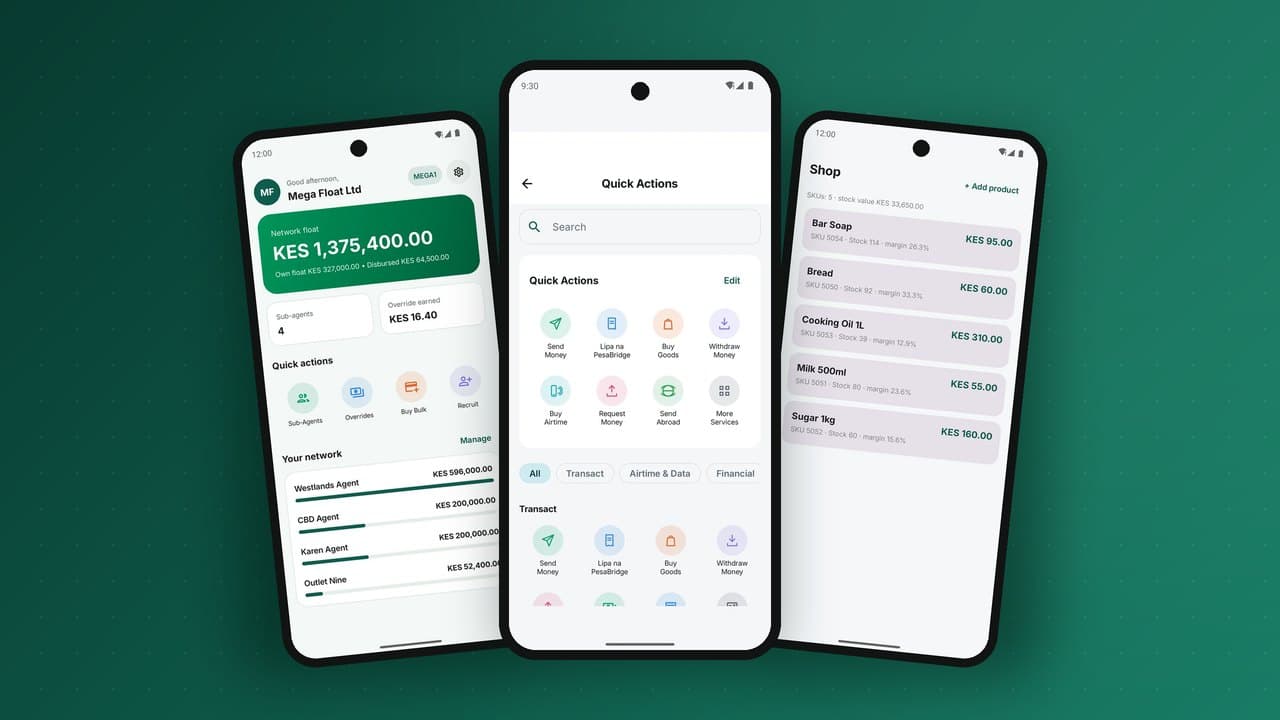
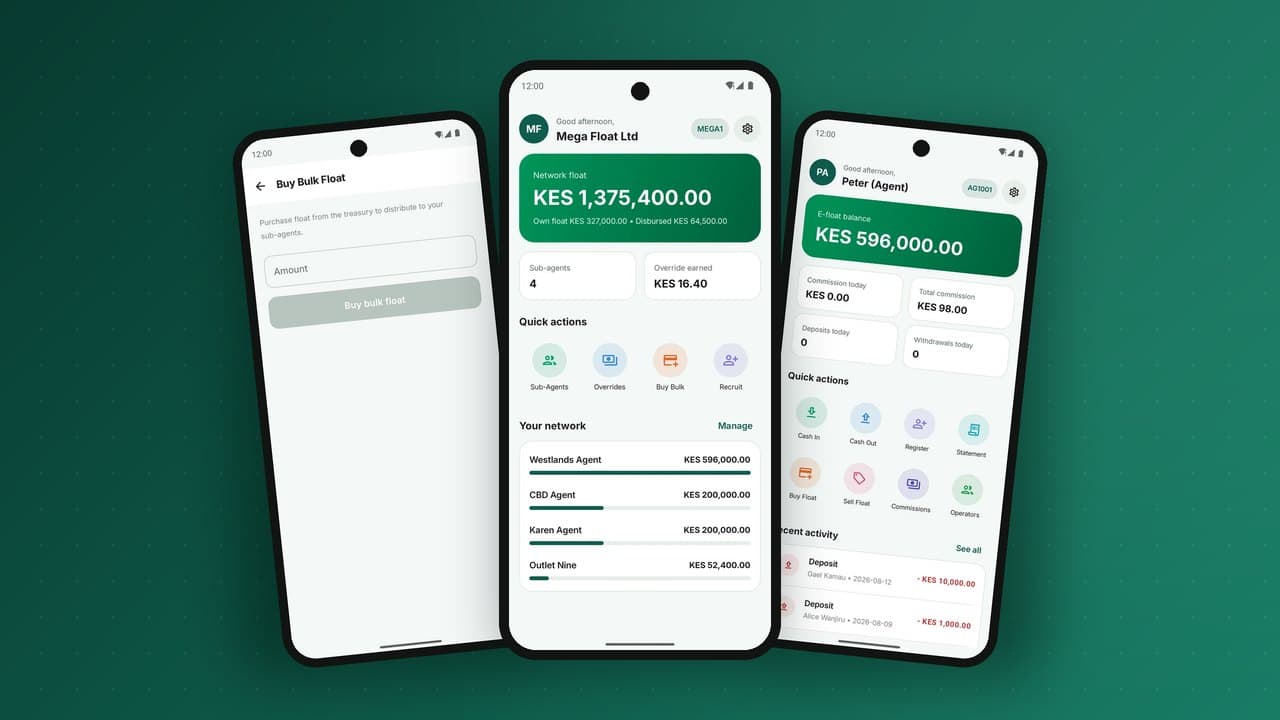
PesaBridge gives every agent live float and commission in the app, float distribution from super-agents to agents that reconciles to the cent, override commission for super-agents, and a back office where your operations team sees every agent, all on a double-entry ledger. See the agent platform or talk to our team.